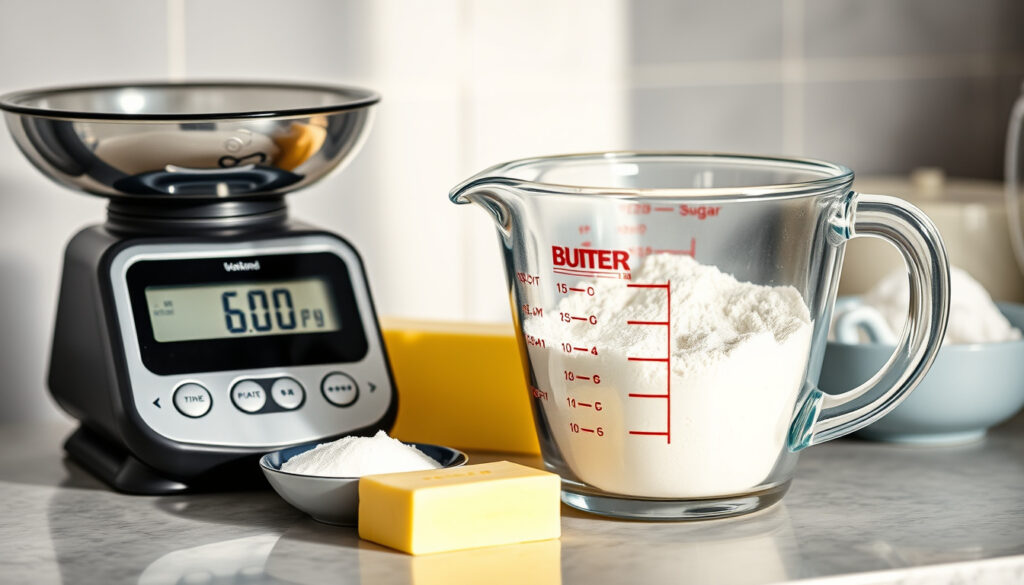
1 Cup in Grams: Conversion Guide for Flour, Sugar, Butter & More
Anyone who’s stared at a recipe that says “1 cup flour” only to wonder if that’s 120g, 125g, or 150g already knows the frustration. The truth is, a cup is a volume measure, and different ingredients pack that volume with very different weights.
1 US cup all-purpose flour: 125 g · 1 US cup granulated sugar: 200 g · 1 US cup unsalted butter: 227 g · 1 US cup whole milk: 240 g · 1 US cup water: 240 g
Quick snapshot
- 1 cup all-purpose flour = 125 g (Brownie Heaven conversion guide)
- 1 cup whole wheat ≈ 130 g (varies by brand) (Brownie Heaven conversion guide)
- Sifting reduces weight by about 10 g (Brownie Heaven conversion guide)
- 1 cup granulated sugar = 200 g (King Arthur Baking (established baking resource))
- 1 cup brown sugar (packed) = 220 g (King Arthur Baking (established baking resource))
- 1 cup powdered sugar = 120 g (King Arthur Baking (established baking resource))
- 1 cup unsalted butter = 227 g
- 1 stick butter = 113 g
- Melted weight equals solid weight
- 1 cup water = 240 g
- 1 cup milk = 240 g
- 1 cup oil = 220 g
The table below summarizes the key measurement facts for quick reference.
| Label | Value |
|---|---|
| US cup volume | 240 ml / 8.45 fl oz |
| UK cup volume | 284 ml / 10 fl oz |
| Flour 1 cup weight | 125 g (spooned and leveled) |
| Sugar 1 cup weight | 200 g (granulated) |
| Butter 1 cup weight | 227 g |
| Water 1 cup weight | 240 g |
A home baker following a US recipe with UK measuring cups is off by 44 ml per cup — enough to turn a tender cake into a dense one.
Is 250g equivalent to 1 cup?
Only if the ingredient has a density of exactly 1 g/ml — which is water. For every other baking ingredient, 250g in a measuring cup lands somewhere different on the scale.
Why does 250g equal 1 cup for some ingredients but not others?
- Water has a density of 1 g/ml, so 240 ml of water weighs 240 g. The metric cup (250 ml) would hold 250 g of water — that’s where the “250g = 1 cup” myth comes from.
- Flour is less dense: it contains air pockets and its particles don’t pack as tightly. A US cup of all-purpose flour holds about 125 g — barely half of 250 g.
- Sugar grains stack more efficiently, so a cup of granulated sugar hits about 200 g.
The pattern: the myth only works for liquids near water’s density. For dry ingredients, 250 g is almost always more than 1 cup.
How to convert 250g of flour to cups
Using the standard 125 g per US cup, 250 g of all-purpose flour equals exactly 2 cups. That’s nearly double the volume you’d get if you assumed 250g = 1 cup.
How to convert 250g of sugar to cups
Granulated sugar at 200 g per cup means 250 g is about 1.25 cups — roughly 1¼ cups (Anna Olson (professional pastry chef conversion data)). Still more than 1 cup, but the gap is smaller than with flour.
The implication: for any baker working by weight, 250 g is a multiple-cup measurement for most dry ingredients, not a default one-cup shortcut.
Is 1 cup of flour 100g?
No — and the difference between 100g and the real value matters enough to change your bake.
How much does 1 cup of all-purpose flour weigh?
- King Arthur Baking (established baking resource): 120 g
- Allrecipes / Brownie Heaven: 125 g
- Doves Farm (UK flour miller): 120 g (US cup unsifted)
The variation comes from how you fill the cup. Spooning and leveling produces 120-125 g. Scooping directly from the bag packs extra flour and can push the weight to 140-150 g (Cotswold Flour (UK milling company technical guidance)).
Why do some recipes say 100g per cup?
Those recipes are likely using a 250 ml metric cup (used in Australia, South Africa) and sifted flour — which Doves Farm lists as about 110 g per US cup. Some round down, but that risks adding up to 40 g extra flour per cup if you’re not sifting.
What is the standard flour cup weight?
For US recipes, the professional standard is 120-125 g per cup of all-purpose flour, unsifted, spooned into the cup, and leveled with a knife. For UK recipes using a 240 ml cup, the same method gives about 120 g. Australia’s 250 ml cup with unsifted flour yields about 125-130 g.
The trade-off: using 100 g per cup saves effort but introduces enough error over multiple cups to make a dry, tough cake.
What is 1 cup in the UK?
The UK cup is different — and confusingly, there are two versions in play.
How many ml is a UK cup?
- Imperial UK cup: 284 ml (10 fl oz) (Doves Farm (UK flour miller with official conversion tables))
- Metric cup (Australia, NZ, South Africa): 250 ml
- US cup: 240 ml
How do UK cups differ from US cups?
A UK imperial cup holds 44 ml more than a US cup — that’s an extra 18% volume. For flour, that means a UK cup of all-purpose flour weighs about 142 g compared to the US 125 g. Using the wrong system can add over 30 g of flour per cup to your recipe.
What cup conversion should I use for UK recipes?
Most modern UK recipes skip cups entirely and give weights in grams. When a UK recipe does use cups, it often means the 240 ml US cup (common in British baking blogs) or the 284 ml imperial cup (older cookbooks). Doves Farm recommends confirming which cup standard the author uses before converting.
Why this matters: using a US cup measure for an imperial-cup recipe shortchanges you by 15-20% of your ingredient.
Is 1 cup equal to 200g?
For granulated sugar — yes, just about. For everything else, no.
Which ingredients have 1 cup = 200g?
- Granulated white sugar: 198-200 g per US cup
- Demerara or turbinado sugar: roughly 200-210 g
Why is granulated sugar close to 200g?
Sugar crystals are dense and pack consistently — there’s minimal air between the grains. Unlike flour, sugar doesn’t compress much when scooped. A cup of granulated sugar is predictably around 200 g, which is why the “200g cup” assumption works only for this one ingredient.
How to avoid confusion with 200g cup claims
If a recipe says “1 cup = 200g” without specifying the ingredient, treat it as sugar-focused advice. For brown sugar (packed), the number jumps to 220 g. For powdered sugar, it drops to 120 g. For flour, using 200 g as the conversion would overfill by nearly 80 g compared to the correct 125 g.
The catch: the 200 g cup myth is a sugar-centric rule that fails everywhere else.
What does 1 cup equal in grams?
Here are the standard US cup to gram conversions for the most common baking ingredients, drawn from authoritative sources.
A baker using weight instead of volume eliminates the margin of error that turns a tender scone into a hockey puck.
1 cup butter in grams
US cup of unsalted butter = 227 g. Anna Olson’s conversion table lists 225 g, a rounding difference of less than 1%.
1 cup milk in grams
Whole milk is close to water’s density. US cup = 240 g.
1 cup water in grams
US cup = 240 g. Because water’s density is 1 g/ml, the volume in ml equals the weight in grams. For UK imperial cup (284 ml), water weighs 284 g.
1 cup sugar in grams
- Granulated: 198-200 g
- Brown (packed): 220 g
- Powdered (unsifted): 120 g
1 cup flour in grams
All-purpose flour (spooned and leveled): 125 g. Sieved flour is about 10 g less.
| Ingredient | 1 US cup (240 ml) | Source |
|---|---|---|
| All-purpose flour | 120-125 g | King Arthur Baking |
| Granulated sugar | 198-200 g | King Arthur Baking |
| Unsalted butter | 227 g | King Arthur Baking |
| Whole milk | 240 g | Brownie Heaven |
| Water | 240 g | Brownie Heaven |
| Cooking oil | 220 g | Standard density conversion |
| Brown sugar (packed) | 220 g | King Arthur Baking |
| Powdered sugar (unsifted) | 120 g | Doves Farm |
For any baker who values consistency, the decision is clear: invest in a digital kitchen scale, use the gram values above, and never rely on “250g = 1 cup” again.
Confirmed facts
- 1 US cup = 240 ml (standardized by US measuring cup makers)
- 1 cup all-purpose flour = 125 g per multiple authoritative sources
- 1 cup granulated sugar = 200 g
The confirmed facts above represent consensus across authoritative baking sources and provide a reliable foundation for consistent results.
What’s unclear
- 1 cup unsalted butter = 227 g (Anna Olson lists 225 g, a rounding difference of less than 1%)
- Some recipe sources use 120 g for a cup of flour (due to different scooping methods)
- The Australian cup is 250 ml — not covered in detail in this guide
- Conversion for brown sugar depends on packing level (light vs firm pack)
These variables highlight why professional bakers prefer weight measurements over volume for precision.
“1 cup of all-purpose flour is 125 g” — Brownie Heaven, conversion guide
Brownie Heaven
“A cup is a unit of volume, not weight, so ‘1 cup in grams’ does not have a single universal answer.”
King Arthur Baking (established baking resource)
The lesson for every home baker: weight is truth. Volume is guesswork. A digital kitchen scale costs the same as two cups of specialty flour and eliminates the margin of error that turns a tender scone into a hockey puck. For any baker who values consistency, the decision is clear: invest in a digital kitchen scale, use the gram values above, and never rely on “250g = 1 cup” again.
For a detailed breakdown of how different ingredients weigh, see our 1 cup in grams conversion guide.
Frequently asked questions
How many grams is 1/4 cup of flour?
About 31 g (1/4 of 125 g). For granulated sugar, 1/4 cup is 50 g. For butter, 1/4 cup is about 57 g.
How many grams is 1/2 cup of butter?
113 g. Since 1 cup of butter = 227 g, half that is 113 g (one standard stick in US measurements).
How many cups is 250g of sugar?
About 1.25 US cups. Granulated sugar weighs 200 g per cup, so 250 g ÷ 200 g = 1.25 cups.
Is there a difference between a US cup and a metric cup?
Yes. The US cup is 240 ml, while the metric cup (used in Australia, New Zealand, and South Africa) is 250 ml. The UK imperial cup is 284 ml. Always check which standard your recipe uses.
Do I need to sift flour before converting cups to grams?
Sifting reduces the weight of a cup of flour by about 10 g. For precision, weigh unsifted flour as the standard and sift if your recipe requires it.
Why do different websites give different gram values for the same cup measurement?
Differences arise from scooping method (scoop-and-level vs dip-and-sweep), sifting, and which cup standard (US vs UK vs metric) the author assumes. Cross-reference with an authoritative source like King Arthur Baking or Doves Farm.
Can I use a regular coffee cup to measure ingredients?
Not recommended. Coffee mugs hold anywhere from 200 ml to 350 ml, with no standard calibration. Using a mug instead of a proper measuring cup can introduce 50% or more error in your ingredient amounts.
More related posts
 Nikolaj Coster-Waldau: Biography, Height, Wife, Languages
 Antoine Semenyo Transfer: Age, Salary & Why He Chose Ghana
 Unscramble Letters to Make a Word – Manual Tips and Free Tools
 Dianna Russini: Scandal, Salary, Husband & What Happened
 Gisele Bündchen: Why She Left Tom Brady, New Baby Father
 Limp Bizkit 2025: Tour, History & Top Songs
 Outlander Season 6 – Premiere Dates, Episodes and Streaming Guide
 Katy Gallagher: Biography, Education, Husband & Career