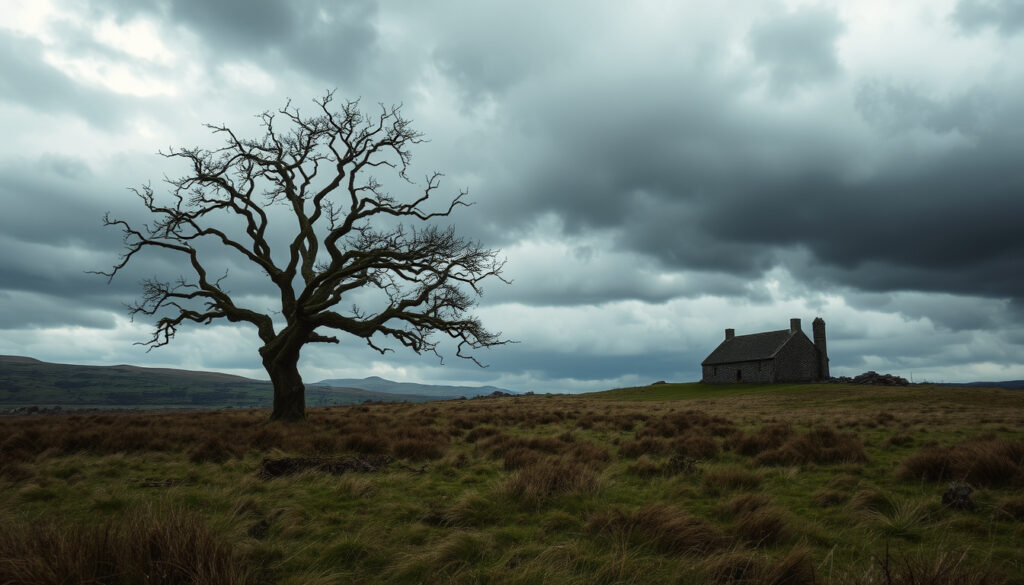
Emily Brontë: The Mysterious Author of Wuthering Heights
Few novelists have left such a deep mark on literature with just one book. Emily Brontë’s Wuthering Heights (1847) shocked Victorian readers with its raw passion and violence, yet today it stands as a classic of English fiction. This article explores her short, reclusive life, the only novel she ever wrote, and the tragic family story behind it all.
Born: 30 July 1818, Thornton, Yorkshire, England ·
Died: 19 December 1848, Haworth, Yorkshire, England ·
Notable work: Wuthering Heights (1847) ·
Number of novels published: 1 ·
Poetry collection: Poems by Currer, Ellis, and Acton Bell (1846) ·
Siblings: Charlotte, Branwell, Anne
Quick snapshot
- Emily Brontë wrote Wuthering Heights and contributed 21 poems to the 1846 collection Poems by Currer, Ellis, and Acton Bell (Poetry Foundation)
- She died of tuberculosis at age 30 (Britannica)
- She never married and had no documented romantic relationships (Biography.com)
- Whether she had any secret romantic attachment or relationship (Biography.com)
- Exact details of her daily life outside the parsonage are scant (Britannica)
- Some poems attributed to her may have alternate authorship (Poetry Foundation)
- The total number of poems she wrote beyond the 1846 collection is unknown (Poetry Foundation)
- 1818–1848: Entire life span — she died just 11 months after Wuthering Heights was published (Britannica)
- 1847: Both Wuthering Heights and Jane Eyre appeared, creating the Brontë literary moment (Britannica)
- Scholars continue to debate the exact authorship of a few poems (Poetry Foundation)
- Adaptations of Wuthering Heights (film, TV, stage) keep her story alive (Poetry Foundation)
Six key facts about Emily Brontë, drawn from authoritative sources, give a quick reference to her identity and output.
| Label | Value |
|---|---|
| Full name | Emily Jane Brontë |
| Nationality | English |
| Occupation | Novelist, poet |
| Genre | Gothic fiction, poetry |
| Years active | 1836–1848 |
| Famous pseudonym | Ellis Bell |
Who was Emily Brontë?
Early life and family
- Emily Jane Brontë was born on 30 July 1818 in Thornton, Yorkshire, the fifth of Patrick and Maria Brontë’s six children (Poetry Foundation).
- She was the second-youngest of the Brontë siblings, with Charlotte (born 1816), Branwell (1817), and Anne (1820) (Britannica).
- After her mother’s death in 1821, the children were raised at the Haworth parsonage by their father and an aunt.
- She attended the Clergy Daughters’ School at Cowan Bridge (1824–1825), but the harsh conditions led to her being brought home permanently.
Personality and reclusiveness
- Emily rarely left Haworth and had few close friends outside her family (Britannica).
- Charlotte Brontë later described her sister as “a solitude-loving, unsocial being” who found peace in the moorland.
- She worked briefly as a teacher at Law Hill School in Halifax (1838) but returned home after six months.
- In 1842, she accompanied Charlotte to Brussels to study languages, but homesickness drove her back to Haworth within a year.
The implication: Emily’s extreme privacy meant that few firsthand accounts of her personality survive, leaving biographers to piece together her character from letters and family recollections.
Literary beginnings
- The Brontë children created elaborate imaginary worlds, writing stories and poems from childhood.
- Emily contributed to the collaborative Gondal saga, a fantasy cycle that later influenced her poetry and novel.
- In 1846, the three sisters jointly published Poems by Currer, Ellis, and Acton Bell under male pseudonyms; only two copies were sold (Wikipedia).
- Undeterred, each sister turned to novel-writing, with Emily completing Wuthering Heights by 1847.
Emily Brontë wrote prolifically in private, yet published almost nothing in her lifetime — just one novel and a handful of poems. Her literary reputation rests almost entirely on work created in a brief creative burst between 1845 and 1847.
The implication: Emily’s reclusive life fueled the myth of the mysterious genius.
Did Emily Brontë only write one book?
Wuthering Heights
- Wuthering Heights is Emily Brontë’s only novel, published in December 1847 under the pen name Ellis Bell (Britannica).
- The novel tells the story of the intense, destructive relationship between Catherine Earnshaw and Heathcliff, set against the Yorkshire moors.
- Contemporary reviews were mixed; the Atlas called it “a strange, inartistic story,” while others praised its power.
- It sold slowly at first but gained attention after Emily’s death, and is now a classic of English literature.
One novel, but its impact: Wuthering Heights has never been out of print and has inspired countless adaptations.
Poetry collaboration with sisters
- Emily contributed 21 poems to the 1846 collection Poems by Currer, Ellis, and Acton Bell (Poetry Foundation).
- Her poems include “Remembrance,” “The night is darkening round me,” and the famous “No coward soul is mine.”
- Critics later noted that her poetry shares the same dark, passionate intensity as her novel.
Other possible writings
- No other novels or major works by Emily Brontë exist, though some poems were published posthumously by Charlotte.
- A fragment of a story, “The Cat,” survives in a miniature manuscript, but it is not a full work.
- Scholars debate whether a few unattributed poems in the Brontë family papers were written by Emily or her siblings.
The limited output raises a question: would Emily Brontë have produced more if she had lived longer? Her death at 30 means we have only one major work to judge her genius — but that one work remains enough to secure her legacy.
The pattern: a single novel can define a legacy.
Why was Wuthering Heights controversial?
Violence and moral shock
- Contemporary critics found Wuthering Heights brutal, immoral, and shocking (Britannica).
- The novel features domestic violence, cruelty, revenge, and an almost amoral antihero in Heathcliff.
- One 1848 reviewer in the Examiner called it “a compound of vulgar depravity and unnatural horrors.”
Unconventional narrative structure
- The story is told through multiple nested narrators — Lockwood and Nelly Dean — which confused some early readers.
- The time structure jumps back and forth, with events spanning thirty years.
- This narrative complexity was considered avant-garde for the Victorian era.
Later critical reevaluation
- By the early 20th century, critics began to see Wuthering Heights as a masterpiece of psychological realism and Gothic romanticism.
- Virginia Woolf wrote that “it is a book of such intense and concentrated passion that it can only be compared to a poem.”
- Today, it is widely taught in universities and hailed as one of the greatest British novels.
What this means: controversy can be a sign of lasting power.
What was Emily Brontë’s famous line?
Iconic quotes from Wuthering Heights
- “I cannot live without my soul” — Catherine Earnshaw’s declaration of her bond with Heathcliff.
- “Whatever our souls are made of, his and mine are the same” — Catherine’s line that expresses their spiritual unity.
- “If all else perished, and he remained, I should still continue to be; but if all else remained, and he were annihilated, the universe would turn to a mighty stranger” — one of the novel’s most quoted passages.
Notable lines from her poetry
- “No coward soul is mine” — the opening line of her most famous poem, written shortly before her death (Poetry Foundation).
- “The night is darkening round me” — another poem that captures her bleak, intense worldview.
- Her poetry is less well-known than her novel, but the best lines demonstrate the same fierce voice.
The pattern: Emily Brontë’s most famous lines — both in prose and poetry — center on the idea of spiritual unity and defiance of death. They resonate because they feel personal, as if she is speaking directly about her own soul.
What was the tragedy of the Brontë family?
Early deaths of siblings
- All six Brontë children died before age 40 (Britannica).
- The two eldest sisters, Maria and Elizabeth, died of tuberculosis in 1825 after being sent to the harsh Cowan Bridge school.
- Branwell, the only brother, died of chronic illness in September 1848 at age 31.
- Emily died of tuberculosis on 19 December 1848, just three months after Branwell.
- Anne died of the same disease on 28 May 1849 at age 29.
- Charlotte, the only sister to marry, died in 1855 at age 38 while pregnant.
Deaths of parents
- Emily’s mother, Maria Branwell Brontë, died of cancer in 1821 when Emily was just three years old.
- Their father, Patrick Brontë, outlived all six of his children, dying in 1861 at age 84.
- After Maria’s death, her sister Elizabeth Branwell moved to Haworth to raise the children; “Aunt Branwell” died in 1842.
Impact on literary output
- The succession of deaths was considered remarkable even in an era of high mortality (Wikisource 1911 Encyclopædia Britannica).
- Charlotte was left as the sole survivor and later edited her sisters’ works, shaping the posthumous reputation of both Emily and Anne.
- The family tragedy gave their novels an added tragic resonance — readers knew the authors had lived through losing everyone.
The Brontë story is not just a literary curiosity; it shaped the content of the novels. Wuthering Heights and Jane Eyre both feature intense emotions, early death, and the fragility of human connection — themes that the Brontës knew intimately.
The catch: the family tragedy is inseparable from their literary achievement.
Timeline
- 30 July 1818: Emily Jane Brontë born in Thornton, Yorkshire (Poetry Foundation).
- 1824–1825: Attends Clergy Daughters’ School at Cowan Bridge; returns home after epidemic (Britannica).
- 1838: Teaches at Law Hill School, Halifax (Poetry Foundation).
- 1842–1843: Studies with Charlotte in Brussels (Britannica).
- 1846: Poems by Currer, Ellis, and Acton Bell published (Wikipedia).
- December 1847: Wuthering Heights published (Britannica).
- 19 December 1848: Dies of tuberculosis at Haworth parsonage (Poetry Foundation).
Emily Brontë lived just thirty years, but the year 1847–1848 was her peak: one novel published, her poetry acknowledged, and then death. The signal is clear: she compressed a lasting literary legacy into a few months.
The implication: a short life can produce timeless work.
Clarity check
Confirmed facts
- Emily Brontë wrote Wuthering Heights and 21 poems in the 1846 collection (Poetry Foundation).
- She died of tuberculosis at age 30 (Britannica).
- She never married and had no documented romantic relationships (Biography.com).
- She was the second-youngest of the Brontë siblings (Poetry Foundation).
What remains unclear
- Whether she had any secret romantic attachment or relationship.
- Exact details of her daily life outside the parsonage are scant.
- Some poems attributed to her may have alternate authorship.
- The total number of poems she wrote beyond the 1846 collection is unknown.
“I am Heathcliff! He’s always, always in my mind: not as a pleasure, any more than I am always a pleasure to myself, but as my own being.”
— Catherine Earnshaw, Wuthering Heights (Emily Brontë, 1847)
“I cannot live without my soul.”
— Heathcliff, Wuthering Heights
“No coward soul is mine, no trembler in the world’s storm-troubled sphere.”
— Emily Brontë, “No Coward Soul Is Mine” (Poetry Foundation)
“Where the artist’s hand was so visible that the work seemed less a story than an emanation of her own wild nature.”
— Charlotte Brontë, 1850 preface to Wuthering Heights
For readers who want to know the real Emily Brontë, the choice is stark: we have her one novel, a handful of poems, and a few letters. That is enough to make her immortal, but not enough to satisfy curiosity about the woman behind the myth. The implication is that we must accept the mystery — or let her work speak for itself.
Compare with the mythic resonance in Saturn Eating His Son: Myth, Meaning, and Goya’s Masterpiece.
en.wikipedia.org, nastywomenwriters.com, thepoetryhour.com, britannica.com, goodreads.com, poetryfoundation.org, kids.britannica.com
Frequently asked questions
Did Emily Brontë ever have a relationship?
There is no documented evidence of any romantic relationship. She never married and no letters or diaries suggest a secret attachment. Biographers agree she likely had no romantic partner (Biography.com).
Was Emily Brontë Irish?
No, Emily Brontë was English. Her father, Patrick Brontë, was born in County Down, Ireland, but the family lived in Yorkshire, England.
Was Emily Brontë a nice person?
Accounts describe her as reserved, independent, and fiercely private. Charlotte Brontë called her “a solitude-loving, unsocial being.” She was not unfriendly, but she kept to herself.
Who is the least popular Brontë sister?
Anne Brontë is often considered the least recognized of the three sisters, though her novels The Tenant of Wildfell Hall and Agnes Grey have gained modern acclaim. Emily’s popularity has always been high due to Wuthering Heights.
What was Emily Brontë’s cause of death?
She died of tuberculosis on 19 December 1848 at age 30 (Britannica). She declined medical treatment in the final stage of her illness.
How is Emily Brontë pronounced?
Her surname is pronounced “BRON-tay” or “BRON-tee,” though the family originally pronounced it “BRUN-tee.”
What is the most romantic line from Jane Eyre?
Though from Charlotte’s novel, not Emily’s, the famous line is: “I am no bird; and no net ensnares me; I am a free human being with an independent will.”
For another story of enduring legacy, read about Chuck Berry: Biography, Songs, and Lasting Legacy.
More related posts
 Rama Duwaji: Ethnicity, Job, Religion & Life as First Lady
 Maternity Leave in Ireland: Complete Guide to Pay & Duration
 Oscar McInerney Retires: Fairytale Premiership, Career Stats & Family
 Audrey Hepburn: Biography, Death Cause & Legacy
 Toyota Land Cruiser 2025: Price, Problems, and Rivals
 Elizabeth Hurley: Billy Ray Cyrus, Age, Net Worth and More
 Sammy Virji: Real Name, Ethnicity, Age & UK Garage Rise
 F1 Melbourne 2026: Sold-Out Race, Tickets & Schedule