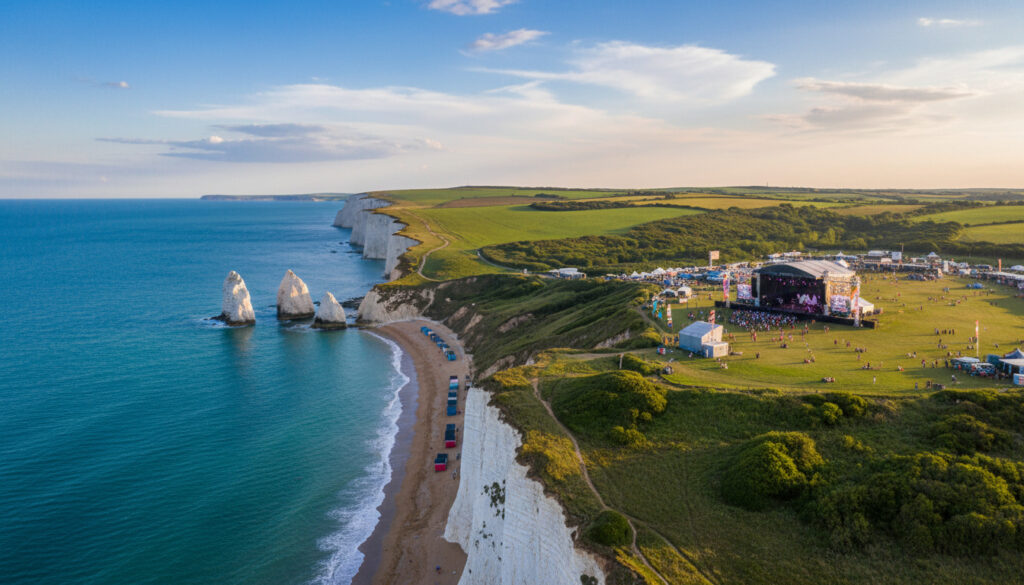
Isle of Wight – Location, Attractions and Festival Guide
The Isle of Wight sits off England’s southern coastline like a diamond-shaped sanctuary, roughly two hours from London via ferry or hovercraft. According to Visit Isle of Wight, the destination is known as “England in miniature” due to its diverse landscapes, including coastlines, woodlands, forests, and landmarks packed into a compact territory.
This geographical gem represents the largest island in England by area, housing approximately 140,000 residents across Victorian resort towns and ancient villages. Its proximity to major ports makes it accessible, while its distinct cultural identity, anchored by the legendary Isle of Wight Festival, draws visitors seeking both relaxation and entertainment.
Where Is the Isle of Wight and How Do You Get There?
Island off southern England coast
147 sq mi (380 km²)
~140,000 residents
Victorian resorts, sailing, festivals
- England’s largest island by total area
- Approximately 2 hours door-to-door from London
- Hosts the revived Isle of Wight Festival since 2002
- Higher proportion of older residents than UK mainland averages
- Connected by three main ferry operators
- Measures 23 miles east-west and 13 miles north-south
| Attribute | Detail |
|---|---|
| Total Area | 147 square miles (380 km²) |
| Dimensions | 23 miles (E-W) × 13 miles (N-S) |
| Highest Point | St. Boniface Down (240m / 787ft) |
| Administrative Center | Newport |
| Population | Approximately 140,000 |
| Distance from London | ~2 hours via ferry/hovercraft |
| Primary Access | Ferry from Portsmouth, Southampton, Lymington |
| Key Towns | Newport, Cowes, Ryde, Shanklin, Ventnor |
Location and Geography
Located in the English Channel, the island lies just off the south coast of England. The terrain spans approximately 23 miles from east to west and 13 miles from north to south, creating a compact but geographically diverse territory that includes the highest point at St. Boniface Down.
Ferry and Travel Options
Three operators provide regular service from the mainland. Wightlink runs routes from Portsmouth (45-60 minutes) and Lymington (30-40 minutes), while Red Funnel operates from Southampton (45-60 minutes for vehicles). Hovertravel offers the fastest crossing, with hovercraft journeys from Southampton taking approximately 25 minutes for foot passengers.
During festival periods, demand spikes significantly. Wightlife Issue 2 (2025) documents increased sailings and special deals for holiday travelers, though advance booking remains essential.
What Are the Best Things to Do on the Isle of Wight?
Top Attractions and Beaches
The island’s heritage sites draw significant interest. Carisbrooke Castle, a medieval fortress where Charles I was held captive, stands alongside Osborne House, Queen Victoria’s former residence. The Needles—chalk stacks rising from the western tip—offer dramatic coastal photography, while Godshill Model Village and Blackgang Chine theme park provide family entertainment.
Beach options range from the sandy expanses of Ryde Beach, suitable for watersports, to the fossil-rich shores of Compton Bay. Bembridge offers shingle and sand combinations, while Shanklin provides a sheltered bay with traditional seaside amenities.
Compton Bay yields dinosaur fossils and features dramatic dunes, making it a focal point for paleontology enthusiasts and walkers alike. The island promotes extensive coastal paths suitable for both hiking and cycling.
Family-Friendly Activities
Beyond beaches, families engage with adventure parks, wildlife spotting, and the annual Wight in Bloom garden awards. The island’s 25-mile coastline supports various water activities, while inland forests offer shaded walking routes. Those planning international family trips might compare these activities to Bluey’s World Brisbane – Guide to Tickets, Location and Hours, though the Isle of Wight offers distinct Victorian seaside charm.
Key Facts About the Isle of Wight
Population and Demographics
The resident population stands at approximately 140,000 according to recent estimates. Demographic data indicates a higher proportion of older residents compared to mainland UK averages, creating a community mix of families, retirees, and seasonal tourists.
Major Towns and Areas
Newport functions as the administrative capital and central hub, hosting the festival site at Seaclose Park. Cowes, located on the north coast, serves as the yachting center. Ryde ranks as the largest town, featuring extensive beaches and Victorian architecture. Shanklin operates as a traditional seaside resort on the south coast, while Ventnor maintains its identity as a historic spa town with distinctive microclimate characteristics.
Isle of Wight Festival and Major Events
Festival Dates and Highlights
The 2025 Isle of Wight Festival runs from Thursday, June 19 through Sunday, June 22 at Seaclose Park in Newport. The lineup includes Sting, Faithless, Amy Macdonald, Dean Lewis, Clean Bandit, and The Lottery Winners, according to festival promotional materials.
The event maintains family zones, camping facilities, and dedicated food areas. Sustainability initiatives feature prominently, with recycling programs and eco-facilities integrated throughout the venue. The Wight Concierge notes the festival combines music programming with environmental consciousness.
Festival periods create significant demand for ferry crossings. Travel guides for 2025 emphasize booking both festival tickets and ferry reservations months in advance, with some services operating at capacity during peak arrival windows.
The festival implements “leave no trace” policies and coastal protection measures. Recycling stations and eco-facilities aim to minimize the environmental impact of the 50,000+ attendees.
How Has the Isle of Wight Changed Through History?
Human activity on the island spans millennia, with distinct periods marking its development from prehistoric settlement to modern tourist destination.
- Prehistoric Era: Evidence of human settlement dates to the Paleolithic era, with archaeological sites indicating continuous occupation.
- Roman Period: Roman villa at Brading represents the island’s integration into the Empire, with visible ruins remaining today.
- Medieval Period: Norman conquest brought Carisbrooke Castle, a fortress that later held King Charles I captive during the English Civil War.
- 1845: Queen Victoria establishes Osborne House as the royal residence, cementing the island’s reputation as a desirable retreat.
- 1968-1970: The original Isle of Wight Festival era begins, culminating in 1970 with over 600,000 attendees witnessing performances by Jimi Hendrix, The Who, and David Bowie.
- 1970-2002: Festival hiatus period following the massive 1970 event.
- 2002: Modern festival revival initiates, continuing annually to the present day.
What Is Definite and What Remains Uncertain?
Distinguishing verified facts from contested claims helps travelers plan accurately.
| Established Information | Information Requiring Confirmation |
|---|---|
| Festival dates: June 19-22, 2025 | UNESCO Biosphere Reserve status—no explicit confirmation found in official records |
| Population: ~140,000 residents | Exact annual visitor statistics vary by source |
| Ferry operators and durations verified | Future infrastructure developments beyond 2025 |
| Area: 147 square miles (380 km²) | Specific economic impact figures post-2025 |
Why Does the Isle of Wight Matter?
The island occupies a unique position in England’s tourism economy, functioning as both a historical repository and contemporary cultural hub. Its proximity to major population centers—within two hours of London—contrasts with its distinct insular identity, creating a destination that combines accessibility with escapism.
Economically, the island relies heavily on tourism and festival revenue, with peak season aligning with summer events. Compared to larger UK islands like the Isle of Man or Shetland, Wight offers denser attractions per square mile but lacks the financial services or oil industries found in those territories. The emphasis on coastal protection and sustainability reflects broader English Channel environmental concerns, positioning the island as a test case for balancing tourism growth with ecological preservation.
For international travelers researching vehicle-based tourism, examining Campervan Hire Melbourne – Best Companies, Prices and Tips provides useful comparison points for the Isle of Wight’s compact, ferry-dependent access model.
What Do Official Sources Confirm?
Documentation from tourism boards and transport operators provides the factual foundation for island statistics.
“The Isle of Wight is known as ‘England in miniature’ due to its diverse landscapes, including coastlines, woodlands, forests, and landmarks.”
— Visit Isle of Wight
“The 2025 festival runs from Thursday, June 19 to Sunday, June 22 at Seaclose Park, Newport, with sustainability initiatives including recycling programs.”
— The Wight Concierge
Key Takeaways About the Isle of Wight
England’s largest island offers 147 square miles of Victorian heritage, prehistoric sites, and contemporary music culture within two hours of London. With ferry connections from three mainland ports, a resident population of approximately 140,000, and the 2025 festival scheduled for June 19-22, the destination balances historical significance with modern entertainment. Travelers should book transport early during festival periods and verify specific UNESCO claims independently.
Common Questions About the Isle of Wight
Is the Isle of Wight expensive?
Costs vary by season, with festival periods commanding premium prices for accommodation and ferries. Off-peak travel offers more moderate rates comparable to mainland UK coastal towns.
What is the best time to visit the Isle of Wight?
Summer months provide optimal beach weather and festival access, though spring and autumn offer milder temperatures with fewer crowds for hiking and historical site visits.
Is the Isle of Wight dog friendly?
Many beaches and coastal paths welcome dogs year-round, with specific restrictions applying only to certain sections during peak summer months.
Do I need a car on the Isle of Wight?
Public buses link major towns efficiently, and cycling routes cover the island’s 23-mile length. Cars provide convenience for remote beaches but aren’t essential for central areas.
Are there dinosaur fossils on the Isle of Wight?
Compton Bay and surrounding southern coast areas contain significant paleontological sites where visitors can spot fossils, though collecting may require permits in protected zones.
What currency is used on the Isle of Wight?
As part of England, the island uses Pound Sterling (GBP). Credit cards are widely accepted, though rural pubs may prefer cash.
More related posts
 Frank Green Discount Code – Latest Verified Offers 2024
 Kathy Hilton Net Worth vs Kyle, Lisa, and Kris Jenner
 Aus Post Near Me: Locations, Hours, Lockers & Delivery
 Unscramble Letters to Make a Word – Manual Tips and Free Tools
 Paul Anthony Kelly: Actor, Wife, Baby, JFK Jr. Role
 Kostya Tszyu: Record, Net Worth, and Life After Boxing
 Barbra Streisand 2024: Health, Relationships, and Latest Updates
 Larry Ellison: Net Worth, Allegations, and Rise to Billionaire