Little Blue Lake Tasmania: Swim, Walk & Blue Wonder Guide
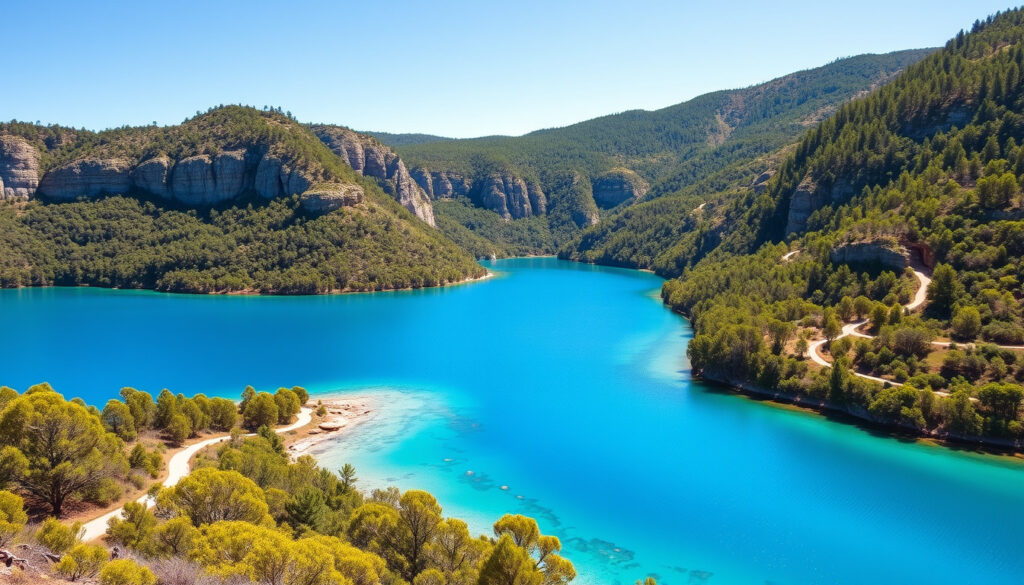
There’s something almost counterintuitive about finding a pool of electric turquoise water tucked into the dry, eucalypt-lined hillsides of northeast Tasmania. Little Blue Lake looks like it belongs somewhere tropical—until you notice the old mine shaft ribs rusting on the bank, and the tin-mining history clicks into place. This former mining pit, abandoned over a century ago, has quietly become one of Tasmania’s most photographed natural surprises. Whether you’re passing through on a road trip from Launceston or basing yourself in the Bay of Fires region, the lake is worth the detour off the B82 highway.
Location: B82 between Derby and Gladstone · Lake length: 300 meters · Color cause: Minerals from tin mining · Drive from Launceston: 2 hours · Origin: Abandoned tin mine
Quick snapshot
- Bright turquoise color from bottom minerals (Discover Tasmania)
- Located just metres off the B82 highway (Discover Tasmania)
- Spans approximately 300 meters in length (Little Falu)
- Exact closure date and operator names of the tin mine
- Precise GPS coordinates for trail markers
- Official water testing data on mineral levels
- Late 1800s–early 1900s: active tin mining hub (Tasmanian Wildlife Tours)
- Early 1900s: mine abandoned, pit fills with water (Tasmanian Wildlife Tours)
- 2010s onward: emerges as tourist destination via social media (Tasmanian Wildlife Tours)
- No formal management by Parks Tasmania
- Visitor numbers growing with social media exposure
- Informal trails likely to remain unmarked
Key details about Little Blue Lake are summarized in the table below.
| Label | Value |
|---|---|
| Location | South Mount Cameron, Tasmania |
| Size | 300 meters long |
| Access road | B82 highway |
| Origin | Tin mining pit |
| Color source | Settled minerals |
Can you swim in Little Blue Lake Tasmania?
Swimming is not recommended. The water contains high concentrations of minerals from the old mine workings, and these can be poisonous if swallowed or absorbed through broken skin. The banks are steep and slippery, adding to the hazard. Tasmania’s official tourism body states this plainly: “Swimming is, nevertheless, not recommended due to the high mineral content in the water” (Discover Tasmania). Some locals do enter the water despite the warnings, but this is done at personal risk.
Swimming conditions
- Water temperature is cold year-round due to the spring-fed source
- Visibility is high—minerals don’t make the water murky—but depth is considerable
- No lifeguards or safety infrastructure on site
Safety considerations
- Do not drink the water—minerals from the tin mining era can be toxic (Mite Visuals)
- No formal swimming area or marked entry points exist
- Steep, unmaintained banks make entry and exit difficult
- The site has no facilities for visitors with access needs (Discover Tasmania)
The same mineral chemistry that makes the lake visually stunning also makes it unsafe for swimming and unsuitable for drinking. Visitors who wade in casually may not realize the water is essentially a mining effluent pond with a toxicity risk.
The implication: until formal water testing and site management are in place, the “no swimming” advisory is the only guidance visitors should follow.
Why is the Little Blue Lake in Tasmania blue?
The vivid aqua-blue hue comes from mineral deposits and white clay in the lake bed. During the tin mining era (1890–1910), open-cut mining operations churned up and concentrated these minerals. When the mine flooded after abandonment, the settled sediment continued to reflect and scatter sunlight in a way that produces that distinctive turquoise cast. “The blue hue comes from mineral deposits and white clay,” notes the Tasmanian Wildlife Tours guide (Tasmanian Wildlife Tours), which has run tours of the region for years.
Mineral composition
- Iron compounds and calcium carbonate from the surrounding geology
- White clay suspended in the water column
- No algae or organic matter contributing to the color
Hydrogeological process
- Spring-fed water source maintains mineral concentration
- No outflow stream—minerals accumulate rather than dilute
- Depth amplifies the color saturation from the surface
“The lake’s vibrant blue hue is thanks to mineral deposits and white clay. It’s nature and history teaming up for a spectacular show.” — Tasmanian Wildlife Tours
The implication: the lake isn’t blue because it’s clean or “pure”—it’s blue precisely because of the mining-era chemistry embedded in its bed and banks. That’s both the appeal and the hazard.
How long is the Little Blue Lake walk?
There are no formal walking tracks around Little Blue Lake, but visitors can walk the perimeter in roughly 30 minutes by picking a path along the bank. The access road from the B82 is a short 44-meter dirt and gravel track suitable for hiking in both directions (Trailforks). Beyond the lake itself, two named hikes start from the carpark.
Trail length and duration
- Sphere Rock Walk: 2km return, about 40 minutes from the Little Blue Lake carpark (Little Falu)
- Cube Rock Hike: 5–6km return, 2–3 hours, moderate difficulty with orange tree markers (Tasvanlife)
- Lake perimeter: approximately 30 minutes with informal routing (Mite Visuals)
Difficulty level
- All paths are unmarked and follow natural terrain
- Orange tree markers guide the Cube Rock route—otherwise navigate by feel
- Unsealed approach roads are manageable for most vehicles with standard ground clearance
For visitors combining Little Blue Lake with the Blue Derby mountain bike trails, the lake perimeter walk offers a quieter, shorter contrast to the managed singletrack network. Pack sturdy shoes—there’s no boardwalk or maintained surface.
The implication: the informal nature of the lake walks is part of the appeal for some, but it also means navigating unmarked terrain with no facilities. First-time visitors should allow extra time to find their way around the bank.
What is special about Little Blue Lake?
Little Blue Lake is special because it’s a rare geological accident with visual drama. An abandoned tin mine became an accidental lake with a color palette that rivals tropical destinations. Unlike purpose-built reservoirs or natural tarns, this site has no managed water level, no artificial stocking, and no tourism infrastructure—just the mineral chemistry and the surrounding scrub doing their work.
Unique features
- One of few turquoise-colored inland lakes in Tasmania
- Former open-cut tin mine with visible historical workings on the bank
- No development—no jetties, pontoons, or concrete edges—which keeps the visual impact intact
Wildlife and nature
- The surrounding northeast Tasmania bushland supports wallabies, echidnas, and a range of birdlife
- No introduced predators (foxes and cats are absent from Tasmania’s ecology, unlike mainland Australia)
- Trails offer opportunities for flora and fauna spotting away from the water’s edge (Tasvanlife)
Tasmania’s northeast has built its tourism reputation around the Bay of Fires and the Blue Derby trails. Little Blue Lake sits between these anchors—close enough for a half-day stop, distinct enough to be worth the detour on its own merits.
The implication: for road trippers combining multiple northeast Tasmania destinations, Little Blue Lake is no longer a hidden secret—it’s becoming an expected highlight that reinforces the region’s reputation for unexpected natural wonders.
How to get to Little Blue Lake Tasmania?
Little Blue Lake sits at 1753 Gladstone Road, South Mount Cameron, Tasmania 7264, just metres off the B82 between Derby and Gladstone (Discover Tasmania). The B82 is the main access route, connecting to the Tasman Highway (A3) via multiple approaches depending on your starting point.
From Launceston
- Distance: 128km, approximately 1 hour 45 minutes via A8, B81, B84/A3, then B82 (Little Falu)
- Route passes through Scottsdale and allows a stop at Derby on the way
- Roads are unsealed in sections but manageable for standard vehicles
From Hobart and St Helens
- Hobart to Launceston: approximately 2.5 hours via the Midland Highway
- St Helens to Little Blue Lake: approximately 50 minutes via the Tasman Highway and side roads
- Fuel available in Derby—fill up before heading to the lake since no services exist on the B82
- Check weather forecasts before departing, as unsealed roads can become slippery after rain (Tasvanlife)
The lake is unmarked from the highway—watch for the informal carpark area off Gladstone Road rather than expecting a signed turnoff. Satnav mapping to “Little Blue Lake” generally works well for the final approach.
The implication: the lack of official signage reinforces that this is an informal, unmanaged site. Visitors who arrive with realistic expectations about the remoteness and lack of facilities tend to enjoy the experience more than those expecting a developed picnic area.
Visitor essentials: what to bring
Given the absence of facilities, a well-stocked day pack makes the difference between a comfortable visit and a frustrating one.
- Water and snacks—nothing is available at the site
- Sturdy walking shoes or boots for informal trails
- Sun protection—open terrain means minimal shade
- Camera or phone for photography—the color is best captured in morning or late afternoon light
- No camping or overnight stays are available or recommended at the lake (Tasvanlife)
Nearby attractions
Little Blue Lake works well as part of a northeast Tasmania circuit. Derby itself has become a destination for mountain biking on the Blue Derby trails, while the Bay of Fires stretch of coastline is an hour’s drive east. St Helens, the gateway to the bay, offers fishing charters, seafood restaurants, and accommodation ranging from caravan parks to eco-lodges.
- Derby: 27km from the lake, 23 minutes via Tasman Highway and B82—fuel, cafes, and the Blue Derby trailhead (Little Falu)
- Bay of Fires: approximately 60km east—white-sand beaches and coastal walks
- St Helens: approximately 50 minutes—game fishing and the largest fishing fleet in Tasmania
“The lake is hidden just off Gladstone Road—you could drive right past it if you weren’t looking.” — TripAdvisor visitor review
The implication: for travelers who plan their northeast Tasmania itinerary around the Bay of Fires and Blue Derby, adding Little Blue Lake costs only an hour of detour time but delivers a photographic payoff that often ends up being their most-shared image from the trip.
Upsides
- Visually stunning turquoise lake unlike anything else in Tasmania
- Short, easy access off the B82 with ample parking
- Connects well with Blue Derby mountain bike trails and Bay of Fires
- Wildlife spotting opportunities away from the water
- Free to visit, no entry fees or bookings required
Downsides
- Swimming is officially not recommended due to toxic mineral content
- No formal walking tracks, facilities, or accessibility features
- No camping or accommodation on site
- Unsealed access roads require careful driving after rain
- Growing popularity risks over-crowding at a fragile site
Related reading: Boat Harbour Beach Tasmania
Frequently asked questions
What things to do at Little Blue Lake Tasmania?
The main activities are walking the perimeter (about 30 minutes), photography of the turquoise water, and tackling the nearby Sphere Rock (2km return) or Cube Rock (5–6km return) hikes. Swimming is not recommended. The site is not suitable for fishing or boating.
Is there accommodation near Little Blue Lake Tasmania?
No accommodation exists at the lake itself. The nearest towns with accommodation options are Derby (27km), St Helens (around 50 minutes), and the Bay of Fires coastline. Derby has caravan parks and basic motels; St Helens offers a wider range including eco-lodges and pubs.
What is the weather like at Little Blue Lake Tasmania?
Northeast Tasmania experiences mild to warm summers (18–25°C) and cool, wet winters. The best time for photography is late autumn through early spring when the water color appears most vivid against the often-overcast sky. Always check forecasts before visiting, as unsealed road conditions can deteriorate quickly.
Are there any predators in Tasmania?
Tasmania is notably free of foxes and feral cats, which have never established on the island. The main native predators are quolls and Tasmanian devils. This makes the wildlife-watching experience different from mainland Australia—wallabies and echidnas are easier to spot without intense predation pressure. Dingos are also absent.
How far is Little Blue Lake Tasmania from St Helens?
The drive from St Helens to Little Blue Lake is approximately 50 minutes via the Tasman Highway and side roads. The route is largely unsealed past the main highway, so check conditions after wet weather.
What makes Little Blue Lake a hidden gem?
The combination of a dramatic turquoise color, complete lack of tourism infrastructure, and mining history gives the lake an “undiscovered” feel that more developed attractions lack. For photographers and road trippers, it’s exactly the kind of serendipitous stop that turns a driving route into an experience.
Best time to visit Little Blue Lake Tasmania?
Late autumn through early spring (May to September) offers the most consistent photography conditions, with softer light and less glare on the water. Summer visits work for bushwalking but the water color is less saturated in bright midday sun, and the site sees more visitors during school holidays.
For road trippers weaving together Tasmania’s northeast coast, the decision is straightforward: add Little Blue Lake to the itinerary, or accept that you’ll be the only one in your travel group who didn’t.
More related posts
 Tips for Remote Work: 10 Proven Strategies for Success
 Hermann Göring: WW1 Ace, Drug Addiction, and Nazism
 Chris Williamson: Biography, Health Diagnosis, Podcast, Net Worth
 Carry On Luggage – Sizes, Rules and Airline Guide
 Carolina Wilga Rescue: How She Survived 11 Nights in the Outback
 2025 Dally M Awards: Winners, Channel, Venue & Recap
 Sammy Virji: Real Name, Ethnicity, Age & UK Garage Rise
 Rowan Atkinson: Wealth, Cars, Wife, Mr. Bean All Questions