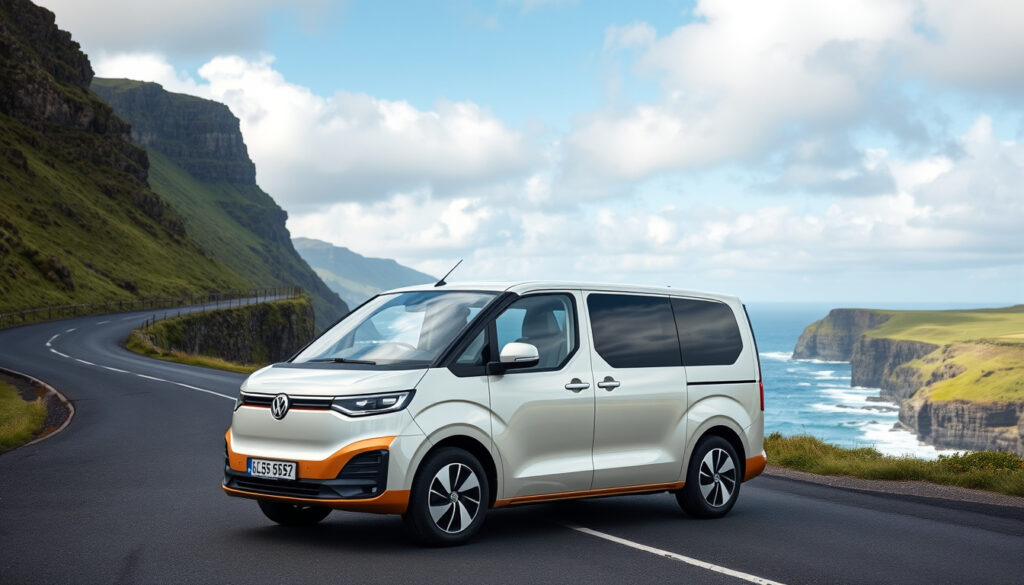
VW ID Buzz Ireland: Price, Range, Features & Facts
Few vehicles carry the cultural weight of VW’s Microbus heritage — and fewer still have arrived with the anticipation the ID. Buzz generated before its launch. Fast-forward to today, and Irish buyers can actually get behind the wheel of one. But with online chatter suggesting the model might be going away, and a starting price that has shifted since orders first opened, it’s worth separating what’s actually happening from what isn’t. This guide runs through the current Irish market reality: pricing, charging, practical living spaces, and whether discontinuation fears are warranted.
Starting Price (Ireland): €67,785 ·
Max Charging Rate: 185kW ·
10-80% Charge Time: 26-30 minutes ·
Used Cars Available: 36 on DoneDeal.ie ·
Seating Options: Up to 7 seats
Quick snapshot
- VW EVs, including ID. Buzz, can charge at Tesla Superchargers (Kelley Blue Book news report)
- 7-seater and cargo versions both exist (Volkswagen Vans Ireland official brochure)
- Named Irish Car & Van of the Year 2023 (Fleet.ie industry award coverage)
- Official Ireland sales figures not publicly disclosed
- Whether 2026 will bring any model year updates for European market
- Precise WLTP range for 2025 specification
- Irish orders opened: August 3, 2022 (Carzone.ie news report)
- European launch: Q3 2022 (VW Media official release)
- US 2026 model year: being skipped (Car and Driver news report)
- Available now in Ireland — new and used stock (MotorTrend news report)
- No Ireland/Europe discontinuation announced (MotorTrend news report)
- US returns 2027 after inventory optimization (MotorTrend news report)
| Field | Value |
|---|---|
| Model | ID. Buzz |
| Starting Price Ireland | €67,785 |
| Battery / Motor | 77kWh / 150kW (204 PS) rear motor, 310Nm torque |
| Max Charging | 185kW DC |
| Charge Time 10-80% | 26-30 minutes |
| Seating | Up to 7 seats (long-wheelbase) |
Why is VW discontinuing the ID. Buzz?
The short answer: VW isn’t discontinuing the ID. Buzz — at least not for Ireland or Europe. The confusion stems from a US-specific decision. In December 2025, Volkswagen Group of America CEO Kjell Gruner confirmed the ID. Buzz would skip the 2026 model year in the US (MotorTrend news report), with sales resuming for the 2027 model year. This is an inventory optimization move, not a cancellation.
The US market saw only 4,934 ID. Buzz units sold through Q3 2025 (Car and Driver news report). At a starting price of $61,545 and with an EPA-rated range of 234 miles, the Buzz faced headwinds from high pricing, the loss of federal EV tax credits after September 2025, and tariffs adding 27.5% to vehicles made in Germany (Autoweek news report). Gruner stated explicitly: “The ID. Buzz remains an important part of the Volkswagen portfolio… We are not canceling this product in the U.S. market.” (MotorTrend news report)
For Ireland and Europe, no model-year skip has been announced. The ID. Buzz remains actively on sale through official Volkswagen retailers.
Model year skip details
The US decision to skip the 2026 model year means no new ID. Buzz inventory will arrive at US dealerships during that model year cycle. Existing stock from the 2025 model year — which entered US showrooms in November 2024 — will continue to be available until supplies clear. This is a calculated move: VW is letting demand catch up to supply in the US market before resuming production allocations.
Future production plans
Volkswagen has confirmed the ID. Buzz returns for the 2027 model year in the US. No details on specification changes have been officially disclosed as of this writing. In Europe and Ireland, current production continues without interruption. The long-wheelbase seven-passenger variant that launched in June 2023 (Wikipedia timeline) remains the flagship configuration for markets requiring maximum passenger capacity.
Why is the VW ID. Buzz not selling well?
The “not selling well” narrative is largely a US story. The US market saw only 4,934 units through Q3 2025 (Car and Driver news report) — a fraction of what a volume model would need. The reasons are specific to the American market context:
Price positioning sits above the average EV transaction price in the US, and the 234-mile EPA range lags competitors by a noticeable margin. The 27.5% tariff on German-made vehicles inflates the US retail price beyond what many buyers expected from a relaunched Microbus. Add the loss of the federal $7,500 EV tax credit after September 2025 (MotorTrend news report), and the value equation weakens considerably.
Sales data insights
US sales data tells a clear story: 4,934 units through Q3 2025 is low for any new model launch. Car and Driver’s reporting (Car and Driver news report) connects the poor performance directly to pricing and range. Autoweek’s coverage (Autoweek news report) reinforces these factors while noting the tariff disadvantage.
Ireland-specific sales figures have not been publicly disclosed, making it difficult to compare directly. However, the ID. Buzz was named Irish Car & Van of the Year 2023 (Fleet.ie industry award coverage), suggesting at least strong critical reception if not raw volume data.
Common owner complaints
Across online discussions, common themes from ID. Buzz owners include software quirks inherited from the MEB platform, range that feels tight for longer trips compared to some competitors, and charging curve behavior that drops off faster than some rivals after the 50% state-of-charge mark. These are consistent with the broader MEB experience rather than ID. Buzz-specific issues.
For Irish buyers, these concerns apply with context: WLTP range of 400-420km is competitive for European usage patterns, and the extensive charging network (including Tesla Supercharger access) mitigates some anxiety.
How much will a VW ID. Buzz cost?
New ID. Buzz models in Ireland start from €67,785 for the base configuration. This reflects current market pricing for the model in the Irish market. For context, when orders first opened in August 2022, Carzone.ie reported a starting price of €41,538 (including VAT and VRT per the official VW Ireland brochure effective July 2022) (Carzone.ie news report) (Volkswagen Vans Ireland official brochure). The current figure reflects pricing adjustments over the intervening years.
Seven-seat long-wheelbase variants carry a premium over the short-wheelbase configuration. Options and trim packages can push prices well above base, as with any premium people-mover. The official Volkswagen Vans Ireland configurator lets buyers build to spec and see exact pricing for their chosen configuration.
The €67,785 starting price positions the ID. Buzz above mid-range EVs but below some luxury people-movers. For buyers who want the Microbus heritage in electric form and need seven seats, the value proposition sits in a specific niche — not cheap, but with limited direct competition.
Ireland pricing
Irish pricing includes VAT and VRT, with the latter calculated on the ODI (Open Market Value) of the vehicle. The official VW Ireland brochure from January 2024 (Volkswagen Vans Ireland official brochure) covers the MY23 specifications and pricing framework. Buyers should check the current configurator or contact a local retailer for exact 2025 model year pricing, as the market continues to evolve. For the most up-to-date pricing and specifications in Ireland, consult the official VW Ireland brochure or contact a local retailer, as the market continues to evolve, and you can find more details on the Australian population 2024.
7-seater variants
The long-wheelbase ID. Buzz with seven seats debuted in June 2023 (Wikipedia timeline) and became the configuration of choice for families needing maximum capacity. Short-wheelbase two-row versions are no longer produced, so all current new orders for passenger use default to the longer body. The Cargo variant, designed for commercial use with a flat load floor, remains available as a separate model line.
Used ID. Buzz listings are emerging in the Irish market — as of this writing, 36 used units were available on DoneDeal.ie, with prices spanning a range depending on mileage, specification, and condition. The growing used market offers an alternative for budget-conscious buyers.
Can you sleep in the ID. Buzz?
The ID. Buzz has attracted interest from camping and overlanding communities precisely because the Microbus heritage evokes road-trip living. The flat floor throughout the passenger compartment (in the long-wheelbase) creates a usable sleeping surface when the seats fold flat. Several owners have documented overnight stays on camping forums, though official VW guidance emphasizes adequate ventilation when occupying any vehicle while stationary.
The Cargo version offers a more practical sleeping setup: the load box in the short-wheelbase Cargo extends to approximately 2.2 meters, providing generous length for a bed. Removing rear seats from a passenger variant also frees up floor space. Roof tents are an option on either body, though buyers should verify roof load capacity with VW Ireland and confirm any mounting implications for the warranty.
Battery preservation mode, noted in VW’s technical documentation (Volkswagen Vans Ireland official brochure), helps maintain the 12V battery during extended periods with the car powered down — useful when parked up for a weekend trip.
Sleeping setup tips
Forum posts from ID. Buzz owners highlight several practical tips: a mattress cut to fit the wheel arch wells, a portable fan for ventilation (mandatory in summer), and consideration of the climate control system’s power draw if running overnight in extreme temperatures. The 77kWh battery provides enough reserve to run climate systems for several hours without significant range loss if you’re plugged in at a campsite.
Cargo and size specs
The ID. Buzz Cargo offers 3.9 cubic meters of load volume in the short-wheelbase. The passenger variant prioritizes occupant space over cargo volume, but folding the third row creates a substantial flat floor area. Interior length in the long-wheelbase passenger model is sufficient for a sleeping mattress oriented front-to-back, and the two-row short-wheelbase was discontinued at the factory level — meaning any used short-wheelbase two-row on the market was likely converted from cargo spec.
The ID. Buzz wasn’t designed as a camper. It’s a people-mover with camper potential. Those expecting a California-class experience will need to invest in bedding, ventilation, and potentially insulation. But for spontaneous weekend road trips, it works if you’re comfortable with basic setup.
Can ID. Buzz use a Tesla charger?
Yes — VW EVs, including the ID. Buzz, have access to the Tesla Supercharger network across Ireland and Europe. This followed VW’s agreement to join the network opened to other brands in 2023. The ID. Buzz supports charging rates up to 185kW on suitable DC fast chargers, meaning a 10-80% charge takes approximately 26-30 minutes at peak power (Carzone.ie news report).
At a Tesla Supercharger, the ID. Buzz will charge at whatever power the station can deliver up to its 185kW maximum. Real-world charging curves typically see the ID. Buzz hold near-peak rates to approximately 50% state-of-charge before tapering — consistent with most EVs using the MEB platform. This makes Supercharger stops practical for longer journeys, adding roughly 200-250km of range during a 26-30 minute charging window.
Supercharger access
Tesla’s Ireland Supercharger network includes locations across major routes. Most Superchargers are open to non-Tesla vehicles, though the specific station availability varies by site. The Tesla app allows ID. Buzz owners to locate compatible chargers, start sessions, and pay through Tesla’s billing system. Pricing per kWh or per minute is set by Tesla and displayed in the app before charging begins.
Not every Tesla Supercharger station supports other EVs — some high-traffic locations have been restricted — but the majority of the network is accessible. VW’s own We Charge program offers alternatives including Ionity and other third-party networks for ID. Buzz owners preferring non-Tesla infrastructure.
Charging compatibility
The ID. Buzz uses the CCS2 connector standard for DC charging, which aligns with the connectors at Tesla Superchargers across Europe (following the network’s transition away from Tesla-specific plugs). For AC charging at home or destination chargers, a Type 2 connector handles the job, with the onboard charger supporting up to 11kW AC input for overnight home charging scenarios.
Irish buyers will find the Supercharger network most useful for longer trips beyond daily commuting range. The 400-420km WLTP range covers most weekly commuting needs without requiring a charging stop, reserving Supercharger visits for occasional longer journeys.
| Specification | Ireland / Europe | United States |
|---|---|---|
| Starting price | €67,785 | $61,545 |
| Battery | 77kWh | 91kWh (long-wheelbase) |
| WLTP / EPA range | 400-420km | 234 miles (~377km) |
| Body styles | Short-wheelbase, long-wheelbase | Long-wheelbase only |
| Model year 2026 | Continues as normal | Skipped (inventory optimization) |
| Charging network | CCS2: Ionity, Supercharger, others | CCS2: Supercharger, Electrify America |
The comparison table reveals how regional market strategies diverge: Irish buyers get both wheelbase options while US customers face long-wheelbase-only availability. Pricing also reflects market-specific factors including currency, taxes, and tariff impacts.
Upsides
- Active availability in Ireland — no waiting for next model year
- Tesla Supercharger access for convenient fast charging
- 185kW charging for quick stops on longer routes
- Up to 7 seats for families needing maximum capacity
- Named Irish Car & Van of the Year 2023
- Cargo variant offers commercial flexibility
Downsides
- Pricing has increased significantly from 2022 launch
- Range trails some competitors at this price point
- No official camper specification (California concept not available)
- Software quirks from broader MEB platform
- US discontinuation confusion creates buyer hesitation
- Used market still small in Ireland (36 listings)
ID. Buzz Timeline
- — Production version unveiled (Wikipedia timeline)
- — Advance sales open in Europe (VW Media official release)
- — Production starts (Wikipedia timeline)
- — Irish orders open at €41,538 (Carzone.ie news report)
- — European market launch (VW Media official release)
- — Long-wheelbase seven-passenger debut (Wikipedia timeline)
- — Named Irish Car & Van of the Year (Fleet.ie industry award coverage)
- — US sales start for 202
More related posts
 Taryn Manning: Biography, Career, and Sobriety Journey
 Wolf Creek: True Story, Reviews, and Franchise Guide (2024)
 Heamasi Makasini: Age, Heritage, Contract & School – Profile 2026
 Chris Bowen: Children, Wife, Religion, and Political Career
 Anita Cobby Murder: Verified Facts and Case Details
 BIG W Capalaba: Location, Hours, Online Shopping & More
 Woolworths Insurance Login: My Insurance Portal Guide
 Chris Kohler: Finance Editor, Author, and Son of Alan Kohler