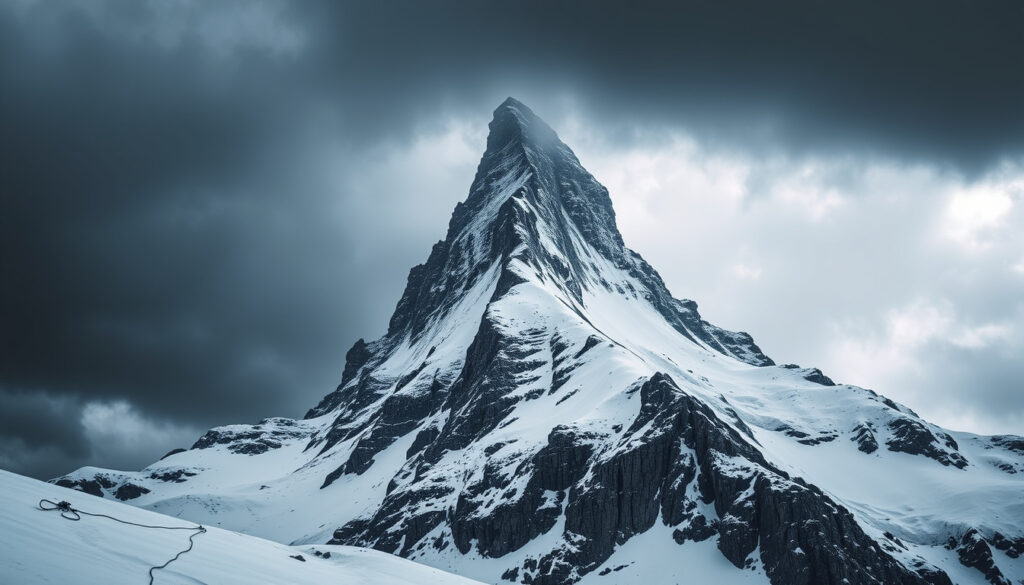
Matterhorn Mountain: Climbing Difficulty and Fatalities
There’s a reason the Matterhorn’s pyramid peak appears on Toblerone wrappers and Swiss souvenirs—it may be the most photographed mountain on the planet, but that fame masks a harsh truth: for over 150 years, this 4,478‑metre icon has been one of the Alps’ deadliest climbs, with a fatality rate per summit attempt that rivals far higher peaks. This guide compares the Matterhorn’s climbing challenge directly against Everest and other notorious mountains, so you can understand the real risks before you tie into the rope.
Height: 4,478 m (14,692 ft) ·
First Ascent: 14 July 1865 ·
Location: Swiss/Italian border, Pennine Alps ·
Annual Climbers: Approximately 3,000 ·
Fatality Rate: Estimated 1 death per 100 summits ·
Shape: Near-symmetric pyramid
Quick snapshot
- Height of 4,478 m (Matterhorn Paradise)
- Located on Swiss-Italian border (Matterhorn Paradise)
- First ascent in 1865 by Edward Whymper’s party (Matterhorn Paradise)
- Over 500 recorded deaths (GearJunkie)
- Exact number of annual deaths due to unreported incidents
- Exact number of climbers per year – estimates range from 2,000 to 4,000
- Claim that the Matterhorn is the “most photographed mountain” lacks independent verification
- Precise fatality rate per summit attempt is uncertain due to underreporting
- 1865 – First ascent; four of seven died (Matterhorn Paradise)
- 1931 – First solo ascent (Matterhorn Chalets)
- 2010s – Record annual summits (over 3,000) (57Hours)
Here is a summary of the key facts about the Matterhorn at a glance.
| Attribute | Value |
|---|---|
| First Ascent Date | 14 July 1865 |
| First Ascent Party | Edward Whymper and party |
| Normal Route | Hörnli Ridge (Swiss side) |
| Climbing Season | July to September |
| Toblerone Connection | Mountain shape inspired Toblerone logo |
Why is the Matterhorn mountain so famous?
The Matterhorn’s near-symmetric pyramid has made it the most photographed mountain in the world, according to Matterhorn Paradise (Swiss tourism authority). But its fame runs deeper than geometry.
Iconic pyramid shape
- The four faces align almost perfectly with the cardinal directions, creating a textbook pyramid silhouette.
- That shape became a national symbol—even the Toblerone chocolate bar’s triangular packaging is a tribute to the Matterhorn, as noted by Matterhorn Paradise.
Role in Alpine mountaineering history
- The first ascent on 14 July 1865 ended in tragedy: four of the seven climbers fell to their deaths on the descent. That story—triumph followed by disaster—cemented the Matterhorn’s place in climbing lore, per Matterhorn Paradise.
- The peak became a testpiece for early alpinists, and success on the Matterhorn signalled a climber’s transition from amateur to serious mountaineer.
Cultural icon
- Beyond chocolate, the Matterhorn appears in films, on Swiss postage stamps, and as a backdrop for countless wedding photos in Zermatt.
- Its fame is so outsized that many travellers assume it’s the highest peak in Switzerland—which it isn’t (that title belongs to Monte Rosa).
Has anyone ever climbed to the top of the Matterhorn?
Yes. Since the first ascent in 1865, thousands of climbers have reached the summit each year. The mountain remains a popular objective for experienced alpinists.
The implication: the Matterhorn’s fame carries a heavy cost for those who underestimate its dangers.
What country owns the Matterhorn?
Sovereignty on the Swiss-Italian border
- The summit ridge forms the border between Switzerland (Valais canton) and Italy (Aosta Valley). Both countries share ownership of the peak itself, as explained by Matterhorn Paradise.
- The Swiss side, facing Zermatt, is by far the more famous—the Hörnli Hut and standard route start from Swiss territory.
Why it is associated primarily with Switzerland
- Zermatt aggressively marketed the Matterhorn as a Swiss icon in the early 20th century, and the Toblerone connection reinforced that identity.
- Italian side access (via Cervinia) is also popular, but most guidebooks, photos, and tourism campaigns feature the Swiss perspective.
Where is the Matterhorn located?
The Matterhorn is located in the Pennine Alps on the border between Switzerland and Italy, near the Swiss town of Zermatt.
The implication: the Matterhorn is genuinely binational, but Swiss branding has won the cultural battle. Italian climbers often argue the peak should be called Cervino, its Italian name.
Is Matterhorn harder than Everest?
A frequent internet debate, and the answer depends on what “harder” means. Let’s separate technical difficulty from altitude challenge.
Technical climbing difficulty comparison
- The Hörnli Ridge (normal route) is rated AD (assez difficile) to D (difficile) on the French alpine scale, requiring solid rock and ice climbing skills with crampons, ice axe, and rope, per 57Hours (climbing guide platform).
- Everest’s standard South Col route is mostly trekking and fixed-line climbing at extreme altitude, with very little technical rock or ice movement.
- In pure mountaineering difficulty, the Matterhorn is more technically demanding than Everest’s normal route.
Altitude and acclimatization
- Everest: 8,848 m. Climbers spend weeks acclimatizing. Severe altitude sickness is a primary risk.
- Matterhorn: 4,478 m. Altitude is manageable for most fit trekkers, though AMS is still possible.
Fatality rates per climber
- Matterhorn: approximately 1 death per 100 summit attempts (roughly 1%). Data from GearJunkie (climbing journalism) estimates about 600 total deaths since 1865 and roughly 3,000 annual climbers.
- Everest: a 2020 study by the University of Washington News (academic research) found the death rate has hovered around 1% since 1990, with a 2026 analysis by Alan Arnette (Everest historian) reporting 1.07 deaths per 100 summits.
- Matterhorn’s per-summit fatality rate is effectively the same as Everest’s—but on a much shorter, less technical (in terms of altitude) route.
Do people still climb the Matterhorn?
Yes. Approximately 3,000 climbers attempt the Matterhorn each year, making it one of the most popular alpine objectives in the world.
The Matterhorn kills as many per summit attempt as Everest does, despite being half the altitude. For climbers with limited high-altitude experience, the Matterhorn is arguably more dangerous because its technical demands catch people off guard.
The pattern: the Matterhorn’s technical difficulty and altitude combine to produce a fatality rate that rivals the world’s highest peak.
The table below compares the Matterhorn and Mount Everest side by side.
| Metric | Matterhorn | Mount Everest |
|---|---|---|
| Elevation | 4,478 m | 8,848 m |
| Technical grade (normal route) | AD–D (rock/ice climb) | Easy snow/ice (fixed lines) |
| Fatality rate per summit | ~1% | ~1% (since 1990) |
| Total recorded deaths | ~600 | 339 (as of 2026) |
| First ascent | 1865 | 1953 |
| Typical climb duration | 2–3 days | 6–8 weeks |
The pattern: the Matterhorn’s technical difficulty and altitude combine to produce a fatality rate that rivals the world’s highest peak. The Everest numbers come from peer-reviewed research in PubMed Central (peer-reviewed medical journal), which found overall odds of dying on Everest were 1.5% and the death rate for climbers descending from the summit was 2.35%.
Can a beginner climb the Matterhorn?
Required skills and experience
- Proficiency with crampons, ice axe, and rope belaying (including crevasse rescue techniques).
- Previous alpine ascents of easier peaks (e.g., Mont Blanc via the Gouter Route) are strongly recommended.
Typical preparation duration
- Most guided ascents require at least 6–12 months prior alpine experience, according to 57Hours.
- Regular climbing three to four times a month in the preceding season is the baseline.
Risks for inexperienced climbers
- The descent is often more dangerous than the ascent: fatigue, loose rock, and rapid weather changes cause accidents.
- Fixed ropes don’t eliminate the risk; novices can make fatal errors in rope management.
Do people still climb the Matterhorn? (Beginner suitability)
While it is technically possible for a beginner with extensive training and a guide, the Matterhorn is not recommended as a first alpine climb due to its high technical demands and fatality rate.
Every year, climbers with no alpine background attempt the Matterhorn on a whim. The rescue statistics show that beginners account for a disproportionate share of incidents.
The catch: the mountain does not forgive inexperience, even with a guide.
What is the deadliest peak in the world?
Fatality statistics for Matterhorn
- Over 500 deaths recorded since 1865, with about six per year in recent decades, per GearJunkie.
- It is consistently listed among the deadliest Alpine peaks, but it is not the deadliest globally.
Comparison with Annapurna and other deadly peaks
- Annapurna I (Nepal) has the highest fatality-to-summit ratio of any 8,000m peak, at approximately 32 deaths per 100 summits, according to Himalayan database records cited by Climbing Kilimanjaro.
- K2 has a ratio of about 1 death per 4 summits (25%), far higher than the Matterhorn.
- Among 4,000m peaks, the Matterhorn is in a deadlier league than most because of its technical sections and high traffic.
How tall is the Matterhorn?
The Matterhorn’s height is 4,478 m (14,692 ft), as verified by Matterhorn Paradise.
For the vast majority of mountaineers, the Matterhorn is the deadliest climb they will ever attempt because it attracts so many climbers per year—approximately 3,000—and each has a 1 in 100 chance of not coming back.
The implication: the Matterhorn’s high traffic amplifies the absolute number of fatalities, making it a consistent risk for climbers.
Pros and cons of climbing the Matterhorn
Upsides
- Unique climbing experience on an iconic peak
- Manageable altitude for experienced climbers (4,478 m)
- Well‑established guided services and hut infrastructure
Downsides
- High fatality rate per summit attempt (~1%)
- Technically demanding, requiring prior alpine experience
- Unpredictable weather and frequent rockfall
How to prepare for a Matterhorn climb
- Build alpine experience. Complete at least two easier 4,000m peaks (e.g., Breithorn, Gran Paradiso) under a guide.
- Hire a certified mountain guide. 57Hours recommends booking through Zermatt’s official guide office.
- Train for stamina. Carry a 15-kg pack on 8-hour hikes with 1,000m elevation gain, several times per week for 2–3 months.
- Practice technical skills. Self-arrest, cramponing on steep ice, and rappelling from anchor points.
- Acclimatize. Spend two nights in Zermatt (1,620 m) before ascending to the Hörnli Hut (3,260 m) for the summit day.
- Check weather and conditions. The season runs July–September; route conditions can change daily.
Following these steps does not eliminate risk, but it substantially improves your chances of a safe ascent.
Timeline: key dates in Matterhorn history
- 1865 – First ascent by Edward Whymper’s party; four of seven died in a fall on descent (Matterhorn Paradise).
- 1931 – Solo ascent by Franz Schmid (Matterhorn Chalets).
- 1960s – Winter ascents become common.
- 1990s – Introduction of fixed ropes on popular routes improves safety.
- 2010s – Record number of annual summits (over 3,000) (57Hours).
The pattern: each era has brought more climbers, but safety improvements have not yet lowered the per‑climber fatality rate.
Safety and risk considerations
Confirmed facts
- Height of 4,478 m (Matterhorn Paradise)
- Located on Swiss-Italian border (Matterhorn Paradise)
- First ascent in 1865 (Matterhorn Paradise)
- Over 500 recorded deaths (GearJunkie)
What’s unclear
- Exact number of annual deaths due to unreported incidents
- Exact number of climbers per year – estimates range from 2,000 to 4,000
- Claim that the Matterhorn is the “most photographed mountain” lacks independent verification
- Precise fatality rate per summit attempt is uncertain due to underreporting
The takeaway: treat all statistics as approximate, and never let a low number lull you into a false sense of safety.
What climbers and guides say
“The Matterhorn is more than a mountain—it’s a national symbol of precision, endurance, and natural beauty.”
Swiss tourism official, Zermatt Tourism
“People underestimate the technical difficulty. A single misplaced crampon step on the upper ridge can be fatal.”
Mountain guide, Hörnli Hut team
Both perspectives underscore the same message: respect the mountain or pay the price.
climbing-kilimanjaro.com, zaratanzaniaadventures.com, 57hours.com, namasadventure.com, alanarnette.com, himalayanglacier.com, en.wikipedia.org, pmc.ncbi.nlm.nih.gov, washington.edu
Frequently asked questions
How long does it take to climb the Matterhorn?
Most ascents from the Hörnli Hut take 6–8 hours up and 4–6 hours down, over two days including approach. Full itineraries often include an acclimatisation day.
What is the best time of year to climb the Matterhorn?
July through September offers the most stable weather and best route conditions. June and October are possible but less reliable.
Do I need a guide to climb the Matterhorn?
Technically no, but virtually all beginners and many experienced alpinists hire a certified guide. The Hörnli route has objective hazards that local knowledge mitigates.
How much does it cost to climb the Matterhorn?
A guided two-day climb typically costs between €1,500 and €2,500, including hut fees, guide fees, and equipment rental. Budget for travel and accommodation in Zermatt.
What equipment do I need for the Matterhorn?
Mountaineering boots, crampons, ice axe, harness, helmet, headlamp, warm layers, and a 30–40 L pack. Your guide will provide ropes and carabiners.
Is the Matterhorn visible from Zermatt?
Yes—Zermatt sits at the foot of the Matterhorn’s north face. Almost every viewpoint in town offers a direct view of the peak.
For anyone considering a Matterhorn climb, the data is clear: this is not a mountain to approach lightly. Either invest months in preparation and hire a certified guide, or choose a less deadly peak for your first alpine experience.
More related posts
 Lara Katseye: Ethnicity, LGBTQ Identity & Biography
 Finding Dory FAQs: Sequel, ADHD, Autism, LGBTQ, and Age Rating
 Noi Vietnamese Eatery – Toronto Location Facts
 Doc Martens: Value, Comfort, and Style Guide
 Bee Venom Cream – Benefits Risks and Evidence
 Amazon Prime Login – Step-by-Step Guide and Fixes
 Kira Pregiato: Latest Verified Facts and Updates (2025)
 Outlander Season 6 – Premiere Dates, Episodes and Streaming Guide