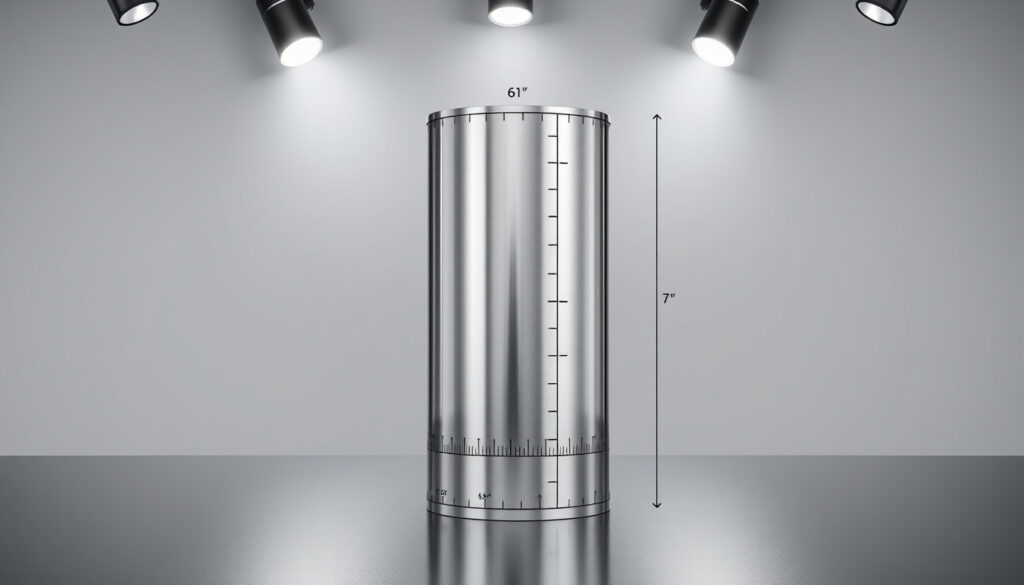
Surface Area of a Cylinder: Formula, Steps & GCSE Examples
If you’ve ever stared at a soda can and wondered how much material went into making it, you’re already thinking about surface area. The good news is that finding the surface area of a cylinder comes down to one reliable formula—and once you see it broken into a few clean steps, it clicks. This guide walks through the exact formula, shows how to apply it with real numbers, and throws in a couple of worked examples pulled straight from GCSE exam-style questions.
Total Surface Area Formula: 2πr(r + h) ·
Lateral Surface Area Formula: 2πrh ·
Top/Bottom Area Each: πr² ·
Key Variables: r = radius, h = height ·
π Value Used: 3.14159
Quick snapshot
- TSA = 2πr(r + h) (K12 Tutoring)
- CSA = 2πrh (Cuemath)
- Derived from rectangle + circles (Math Open Reference)
- Exact AQA/Edexcel source materials not publicly archived
- Video publication dates vary across YouTube sources
- GCSE cylinder videos published 3–5 years ago target UK curriculum (YouTube GCSE Maths)
- Formula structure unchanged across UK exam boards (YouTube GCSE Maths)
- Practice with diameter-based problems
- Work toward three significant figures in final answers
| Label | Value |
|---|---|
| Standard Formula (TSA) | 2πr(r + h) |
| Lateral Formula (CSA) | 2πrh |
| Base Area Each | πr² |
| Variables Defined | r: radius, h: height |
| π Precision | Leave as π or use 3.14 |
What is the formula for the surface area of a cylinder?
A cylinder has three parts that matter for surface area: two circular ends and one curved side. The total surface area (TSA) formula combines all three into one expression. The standard form reads 2πr(r + h), where r is the radius of the circular base and h is the height of the cylinder (K12 Tutoring). This simplifies to 2πr² + 2πrh when you expand it, which some students find easier to visualise.
Breaking it down: the two circular bases each cover an area of πr², so together they contribute 2πr². The curved surface unwraps into a rectangle whose width equals the circumference of the base (2πr) and whose height equals h, giving an area of 2πrh (Math Open Reference). Add those pieces together and you have the complete enclosure.
Total surface area (TSA)
- TSA = 2πr² + 2πrh = 2πr(r + h)
- Includes both circular bases plus the curved side
Lateral surface area (CSA)
- CSA = 2πrh
- Curved side only—ignores the top and bottom
Top and bottom areas
- Each base: πr²
- Both bases combined: 2πr²
A can of soup and a drainpipe have the same CSA if their circumferences and heights match—but their TSA differs because the can has sealed ends. Knowing which version you need keeps your answer from being marked wrong in an exam.
How do I find the surface area of a cylinder?
The step-by-step process works the same whether you’re handling a textbook problem or a real-world measurement. According to The Knowledge Academy, the standard four-step approach is: identify your radius and height, calculate the area of both bases, calculate the curved surface, then add everything together.
Step-by-step calculation process
- Step 1: Measure or note the radius r and height h (units must match)
- Step 2: Calculate 2πr² for the two bases
- Step 3: Calculate 2πrh for the curved surface
- Step 4: Add the results: 2πr² + 2πrh = TSA
Example with numbers
Take a cylinder with r = 5 cm and h = 8 cm. Using the formula 2πr(r + h):
- TSA = 2π × 5 × (8 + 5)
- TSA = 2π × 5 × 13
- TSA = 130π ≈ 408.41 cm²
This matches the verified result from Cuemath, which confirms r = 5 cm, h = 8 cm yields 408.41 cm².
Using diameter instead of radius
If a problem gives you the diameter d instead of the radius, remember r = d ÷ 2. Some GCSE questions use the diameter form directly: TSA = ½πd(d + 2h) (YouTube GCSE Maths). This cuts out the radius-conversion step, which can save time under exam pressure.
GCSE mark schemes typically accept both forms—πr² + πr² + 2πrh or the compact 2πr(r + h)—but some shorter exam questions specifically ask for the answer “in terms of π,” which means you should leave the result as 130π rather than converting it to a decimal.
How to calculate surface area of a cylinder in terms of pi?
Leaving answers in terms of π means you write the result as a multiple of π rather than approximating it as a decimal. This is the preferred approach in GCSE exams because it keeps answers exact and avoids rounding errors that creep in when you multiply by 3.14 too early (JP Maths Revision).
Leaving pi symbolic
- TSA = 2πr(r + h) stays as 2πr² + 2πrh
- Answer expressed as 130π, not 408.41
- Units remain cm² or m² as appropriate
Approximating with 3.14
If an exam doesn’t specify “in terms of π,” you can approximate. Using π ≈ 3.14, the same cylinder (r = 5, h = 8) gives 130 × 3.14 = 408.2 cm² (Math Grizz). The small difference from 408.41 reflects rounding during the calculation.
Exact vs approximate
- Exact: 130π cm² (leave π in the answer)
- Approximate: 408.2 cm² or 408.41 cm² (depends on rounding steps)
The implication: if a problem says “give your answer to 3 significant figures,” you must convert to decimal. But if it reads “leave your answer in terms of π,” writing 130π scores full marks while 408.41 would not.
What is surface area of a cylinder without ends?
An open cylinder—like a pipe, a drain, or a length of gutter—has no top or bottom faces. That means you’re only calculating the curved surface area (CSA), which is 2πrh (Cuemath). The two circular ends drop out of the formula entirely.
Lateral surface only
- CSA = 2πrh
- No 2πr² component from the bases
Formula and derivation
Imagine unrolling the curved surface of the cylinder. The result is a rectangle whose width equals the circumference of the base (2πr) and whose height equals h. Multiply those dimensions and you get 2πrh—nothing more (Math Open Reference).
Real-world like pipes
- A drainpipe 14 cm tall with radius 7 cm has CSA = 2π × 7 × 14 ≈ 615.8 cm² (Cuemath)
- Painters calculating coverage need CSA, not TSA, when coating the outside of a pipe
For a student revising for exams, the key is to read the question: “total surface area” means TSA, while “curved surface area” or “lateral surface area” means CSA. One letter difference in the question changes which formula you reach for.
Surface area of a cylinder GCSE?
GCSE exam questions tend to present cylinder problems in two ways: either a straightforward “find the TSA” with given dimensions, or a reverse problem where you’re given the TSA and asked to find a missing dimension. Both require the same core formula, but the reverse questions test algebraic rearrangement—a common exam trap.
AQA and common exam questions
Typical AQA-style questions give you r and h directly, or give the diameter d and height h, and ask for the answer in terms of π or to three significant figures. One common question type gives TSA = 162π cm² and h = 24 cm, then asks you to find the diameter (JP Maths Revision). This requires solving backwards from the formula.
Worked examples from BBC Bitesize
The BBC Bitesize approach walks students through identifying r and h, writing the formula, substituting values, and giving the answer in the correct form (YouTube GCSE Maths). For a cylinder with r = 5 cm and h = 12 cm, the TSA works out to approximately 741 cm² to three significant figures.
Common mistakes
- Forgetting to double the base area: Each base is πr², not πr² for both
- Mismatched units: If r is in cm and h is in m, convert one before calculating
- Confusing TSA and CSA: Read the question carefully—”curved surface” vs “total surface”
- Rounding too early: Keep π symbolic until the final step if “in terms of π” is requested
Watch for diameter vs radius on the mark scheme. If the question gives d = 3 m and h = 8 m, don’t plug d straight into 2πr(r + h)—either convert d to r = 1.5 m first, or use the diameter form ½πd(d + 2h) (YouTube GCSE Grade 5). Mixing formulas mid-calculation is a reliable way to lose marks.
How to calculate surface area of a cylinder
The four steps below cover every GCSE-style cylinder problem. Work through them in order, and adapt the final step depending on whether the question asks for TSA or CSA.
- Identify r and h. Read the question carefully. If it gives the diameter, halve it to get r. Confirm both measurements use the same units.
- Calculate the area of both bases. Use πr² for one base, then multiply by 2 for both: 2πr².
- Calculate the curved surface. Multiply 2 × π × r × h to get the lateral area: 2πrh.
- Add the components. For TSA: 2πr² + 2πrh. For an open cylinder (CSA only): skip step 2 and answer 2πrh.
For r = 4 ft and h = 10 ft: the TSA calculation is 2π × 4 × (10 + 4) = 2π × 56 = 112π sq ft (K12 Tutoring). If the problem asks for a decimal answer, 112 × 3.14 ≈ 351.68 ft².
Confirmed facts and uncertainties
Confirmed facts
- TSA formula is standard across all UK exam boards: 2πr(r + h)
- CSA formula: 2πrh
- Curved surface unrolls to rectangle (circumference × height)
- Units must match for r and h before calculation
What’s unclear
- Specific AQA/Edexcel past paper questions not publicly archived in this research
- Exact publication dates for some GCSE YouTube videos remain unverified
What experts say
“The surface area of a cylinder is going to be 2 pi r times r plus h.”
— GCSE Maths Tutor (YouTube GCSE Maths)
“TSA = 2πr(r + h).”
— Cuemath (Math Education Site)
“The surface area is going to be 2 π r squared plus 2 π r h.”
— JP Maths Revision (GCSE Revision Tutor)
Summary
The surface area of a cylinder hinges on one formula—2πr(r + h) for total area, or 2πrh for just the curved side—and a handful of consistent habits: check your units first, decide whether the question wants TSA or CSA, and resist the urge to convert π to 3.14 until the end unless the question specifically asks for it. For GCSE students, the difference between 130π (exact) and 408.41 (rounded) could mean the difference between full marks and a dropped mark. Practice with diameter-based problems until the r = d ÷ 2 conversion becomes second nature, and treat every “find the diameter” question as an algebra problem dressed up in a geometry problem’s clothing.
Related reading: TSA formula · step-by-step examples
GCSE students applying the total surface area formula 2πr(r + h) will find familiar step-by-step workings in the cylinder area formula guide, complete with practical examples.
Frequently asked questions
What units to use for cylinder surface area?
Both the radius and height must use the same unit (centimetres, metres, millimetres, etc.). The result always comes out in square units—cm², m², mm²—because you’re measuring area (The Knowledge Academy).
Difference between TSA and CSA?
TSA (total surface area) includes both circular bases plus the curved side. CSA (curved/lateral surface area) counts only the curved side, excluding the two ends (Cuemath).
How to calculate if radius unknown?
If the diameter is given instead, divide it by 2 to get the radius (r = d ÷ 2). Alternatively, use the diameter form: TSA = ½πd(d + 2h) (YouTube GCSE Maths).
Is volume same as surface area?
No. Volume measures how much space a cylinder holds (πr²h). Surface area measures how much material covers its exterior. They use completely different formulas and yield different units (cm³ vs cm²).
Cylinder surface area with radius 5 cm height 10 cm?
Using 2πr(r + h): 2π × 5 × (10 + 5) = 2π × 5 × 15 = 150π ≈ 471.24 cm². The answer can be left as 150π or converted to decimal, depending on what the question asks for.
Why use pi in formula?
Pi (π ≈ 3.14) appears because circles are part of the cylinder’s structure. The circumference of the base is 2πr, and the area of each base is πr². Both are fundamental properties of circles that carry through into the surface area formulas.
Open cylinder surface area?
An open cylinder—like a pipe or tunnel—has no top or bottom, so you use only the curved surface area: CSA = 2πrh. This excludes the 2πr² term entirely (Cuemath).
More related posts
 Language Academy Login – Official Portals and Password Reset
 Abella Danger Now: Retirement, Net Worth, and Life in 2025
 Chris Bowen: Children, Wife, Religion, and Political Career
 Kathy Hilton Net Worth vs Kyle, Lisa, and Kris Jenner
 National Geographic: How to Watch, History & Stance
 Holt McCallany: Biography, Career, and Personal Life
 Antoine Semenyo Transfer: Age, Salary & Why He Chose Ghana
 Builder Near Me: Hiring, Co t & Rule in Ireland