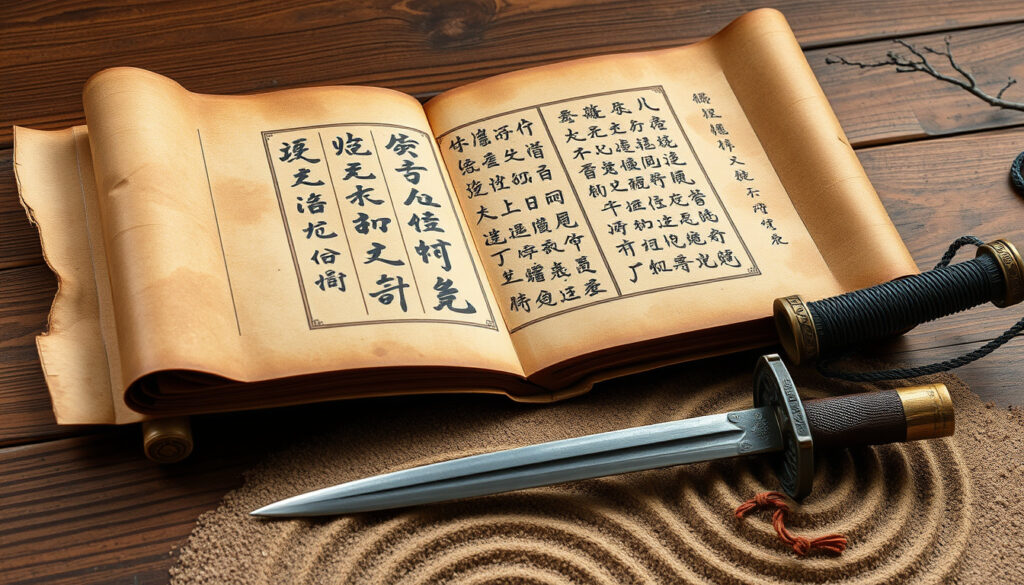
Sun Tzu: The Art of War, Quotes, and History
Few ancient figures command as much modern attention as Sun Tzu — yet the man behind The Art of War remains surprisingly elusive. His 2,500-year-old text is studied by generals and CEOs alike, but historians still argue over whether he ever actually lived.
Century lived: 6th century BCE (approx.) ·
State served: Wu (China) ·
Known for: The Art of War, 13 chapters ·
Primary source: Sima Qian’s Records of the Grand Historian (c. 100 BCE) ·
Historical certainty: Debated; no contemporary records
Quick snapshot
- Lived circa 544–496 BCE (traditional) (World History Encyclopedia)
- Served King Helü of Wu (Wikipedia)
- Author of The Art of War (Wikipedia)
- 13 chapters (World History Encyclopedia)
- Focus on strategy, terrain, deception (Association for Asian Studies)
- Studied globally for 2,500 years (The Conversation)
- Existence debated (The Conversation)
- No personal battle records (The Actuary)
- Anecdotes from Sima Qian (200 years later) (The Conversation)
- Used in military academies (The Conversation)
- Applied in business, sports, politics (World History Encyclopedia)
- Popular culture references (Cambridge University Press)
Key facts about Sun Tzu
Five essential data points that frame the discussion of Sun Tzu and The Art of War.
| Attribute | Value |
|---|---|
| Full name | Sun Tzu (Sunzi) — |
| Era | Spring and Autumn period, ancient China |
| Text attribution | The Art of War (Sunzi Bingfa) |
| Total chapters | 13 |
| Primary historical source | Sima Qian, Records of the Grand Historian (c. 94 BCE) |
What is Sun Tzu’s most famous quote?
The quote “To know your enemy, you must become your enemy” is often misattributed
That phrase appears in none of the 13 chapters. The closest sentiment comes from Chapter 6: “If you know the enemy and know yourself, you need not fear the result of a hundred battles.” The misattribution likely spread through social media and film adaptations. A quick check of the original text reveals no such wording. (Wikipedia — list of quotes)
Actual top quote from the text: “Appear weak when you are strong, and strong when you are weak.”
This line from Chapter 1 captures the core principle of deception that runs through The Art of War. The Association for Asian Studies notes that the text’s emphasis on surprise and misdirection reflects the changing nature of warfare during the Warring States period.
Most cited on Goodreads: “To subdue the enemy without fighting is the acme of skill.”
From Chapter 3, this quote is the most-liked on Goodreads. It elevates psychological victory over brute force, which explains its appeal beyond military readers. The The Conversation observes that this principle is what makes the book relevant to managers, diplomats, and athletes today.
The implication: Readers should verify attributed quotes against the original text to avoid common misrepresentations.
Why is Sun Tzu so famous?
His sole attributed work, The Art of War, is studied in military academies and business schools worldwide
- The U.S. Military Academy at West Point includes The Art of War in its strategic reading list. (World History Encyclopedia)
- Stanford Graduate School of Business and Harvard Business School have used the text in leadership courses. (The Conversation)
Influence extends to sports, politics, and modern management
NBA coaches have quoted Sun Tzu during playoffs; politicians reference “know your enemy” in debates. The Cambridge University Press notes that the text’s principles are applied across disciplines because they are abstract enough to be adapted yet concrete enough to provide actionable advice.
Historical mystery adds to his legend
The Conversation points out that the lack of contemporary records makes Sun Tzu a blank slate onto which readers project their own interpretations. The uncertainty — was he a general? a philosopher? a myth? — fuels endless curiosity.
Sun Tzu’s fame is not just about military history; it’s a case study in how a short, ambiguous text can become a universal management tool. For anyone teaching strategy, the book offers a pre-scientific model of competitive reasoning that still feels modern.
The pattern: The text’s adaptability to modern contexts, combined with the mystery of its author, ensures its continued relevance.
What are the 5 principles of Sun Tzu’s Art of War?
The five constant factors: Moral Influence, Weather, Terrain, Command, Doctrine
In Chapter 1, Sun Tzu lays out these five factors for assessing a situation. The World History Encyclopedia summarizes them: Moral Influence (shared purpose), Weather (environmental conditions), Terrain (ground and logistics), Command (leadership competence), and Doctrine (organization and discipline).
The principle of deception: ‘All warfare is based on deception.’
Perhaps the most quoted line from Chapter 1. The Association for Asian Studies notes that this principle permeates the text, emphasizing the importance of misdirection over brute force.
Speed and preparation: ‘Speed is the essence of war.’
From Chapter 2, this principle values swift action over prolonged conflict. The Cambridge University Press contextualizes this within the Warring States period, where protracted campaigns were ruinous.
| Factor | Focus | Chapter reference |
|---|---|---|
| Moral Influence | Unity of purpose | 1 |
| Weather | Environmental conditions | 1 |
| Terrain | Ground and logistics | 1 |
| Command | Leadership competence | 1 |
| Doctrine | Organization and discipline | 1 |
| Deception | Misdirection | 1 |
| Speed | Swift action | 2 |
What this means: The principles are not exhaustive but offer a systematic approach to strategy that remains applicable across domains.
Was Sun Tzu ever defeated?
No record of Sun Tzu’s own military campaigns exists
The The Actuary states flatly: “no historical records of Sun Tzu have ever been found.” Without documentation of any battle, the question of defeat remains unanswerable.
The Art of War does not describe any defeat of its author
The text is theoretical, not autobiographical. According to World History Encyclopedia, Sun Tzu’s biography consists almost entirely of anecdotes recorded two centuries later by Sima Qian.
Historical accounts focus on his teaching and writing
Sima Qian’s narrative, as cited by The Conversation, covers only Sun Tzu’s demonstration of tactics with the king’s concubines (see next section) and his subsequent service as a general — but no specific battles are described.
Sun Tzu’s authority as a strategist rests entirely on a text that never mentions his own combat record. For modern readers, this means the wisdom stands or falls on its own merit, not on the author’s resume.
The catch: Without documented victories or defeats, the text’s credibility must be evaluated on its logical consistency and practical utility.
Did Sun Tzu execute concubines?
The story appears in Sima Qian’s biography of Sun Tzu
According to the The Conversation, Sun Tzu was asked to train the king’s 180 concubines as soldiers. When they laughed instead of following orders, he executed the two lead concubines. The rest of the group then drilled perfectly.
He allegedly executed two concubines to discipline a drill
The The Conversation notes this anecdote is one of the most famous — and controversial — in Chinese historiography.
Historians debate the story’s veracity
Given the lack of contemporary records, many scholars treat the concubine execution as a moral fable rather than a literal event. The Cambridge University Press discusses how such anecdotes function to reinforce the idea that Sun Tzu was a strict disciplinarian, regardless of historical accuracy.
Timeline signal: Key events in the Sun Tzu story
- — Traditional lifespan of Sun Tzu (varies by source) (World History Encyclopedia)
- — Sun Tzu allegedly demonstrates his methods by executing the king’s concubines (Sima Qian account) (The Conversation)
- — Earliest known compilation of The Art of War text (later additions probable) (Cambridge University Press)
- — Sima Qian writes biography of Sun Tzu, incorporating the concubine story (The Conversation)
- — The Art of War introduced to Europe via French translation (World History Encyclopedia)
- — Lionel Giles publishes definitive English translation (World History Encyclopedia)
- — Rise in popularity in business, sports, and popular culture (The Conversation)
Confirmed facts
- The Art of War is a real ancient Chinese text (World History Encyclopedia)
- The text has 13 chapters covering strategy (World History Encyclopedia)
- Sun Tzu is credited as author in tradition (Wikipedia)
- The work influenced military thought globally (Cambridge University Press)
What’s unclear
- Whether Sun Tzu was a single historical person (The Conversation)
- Personal details of Sun Tzu’s life (birth/death dates, battles) (The Actuary)
- The concubine execution story’s authenticity (The Conversation)
- Sun Tzu’s exact IQ (an anachronistic question) (The Conversation)
The pattern: The contrast between confirmed textual facts and uncertain biographical details underscores the need to separate the book from the man.
Quotes from the sources
“To subdue the enemy without fighting is the acme of skill.”
— Sun Tzu, The Art of War, Chapter 3 (cited by World History Encyclopedia)
“The supreme art of war is to subdue the enemy without fighting.”
— Sun Tzu, The Art of War, Chapter 3 (another translation via The Conversation)
“Sun Tzu… killed the two chief concubines and replaced them with his own people. Then he trained the remaining 178 women, and they never laughed again.”
— Sima Qian, Records of the Grand Historian (summarized by The Conversation)
“The translation of this short Chinese classic has had a remarkable career. It has been translated into many languages and has been studied by people who never intended to go to war.”
— Lionel Giles, Introduction to his 1910 translation (cited in World History Encyclopedia)
The reality is that Sun Tzu is both less and more than a historical figure: less because we may never know if he actually existed; more because the text attributed to him has shaped strategic thinking across cultures and centuries. For a reader picking up The Art of War today, the choice is clear: either engage with the principles themselves and leave the historicity to scholars, or explore the debate and accept that the legend may be as powerful as any fact.
Related reading: **Audie Murphy: America’s Most Decorated WWII Hero** · **Hermann Göring: WW1 Ace, Nazi Leader Facts**
youtube.com, facebook.com, classicsofstrategy.com, reddit.com
For a deeper dive into the strategic principles, explore Sun Tzus The Art of War and its enduring lessons on deception and warfare.
Frequently asked questions
What is the correct pronunciation of ‘Sun Tzu’ in English?
In English, “Sun Tzu” is commonly pronounced “soon-dzoo” (with a soft ‘dz’ sound). In Mandarin, the surname Sun is pronounced “swun” and Tzu as “dzuh”.
Can The Art of War be applied to modern business?
Yes. Many executives and management consultants use the text for competitive strategy, negotiation, and organizational leadership. The principles of deception, speed, and assessment are adaptable beyond warfare. (The Conversation)
How many copies of The Art of War have been sold?
Exact sales figures are not known, but it is frequently cited as one of the best-selling Chinese classics, with millions of copies in print across dozens of languages. (World History Encyclopedia)
What languages has The Art of War been translated into?
It has been translated into every major language, including English, French, German, Russian, Japanese, and many others. The first European translation was into French in the 18th century. (World History Encyclopedia)
Is The Art of War a long book?
No, it is very short. The English translation is roughly 40–60 pages, depending on the edition. It can be read in a few hours. (World History Encyclopedia)
Are there reliable free translations of The Art of War online?
Yes. Project Gutenberg offers the Lionel Giles translation (1910) in the public domain, and MIT provides an academic translation on its website. (Wikipedia)
More related posts
 Heamasi Makasini: Age, Heritage, Contract & School – Profile 2026
 How to Reset Network Settings on iPhone: Step-by-Step Guide
 Zac Efron: Jaw Surgery, Agoraphobia & Health Timeline
 Kai Kara-France: Ancestry, Real Name, UFC Status & Record
 Mission Impossible The Final Reckoning – Release Date, Cast, Trailer Details
 Lady Sarah Chatto
 Candace Owens Biography: Verified Facts and Controversies
 Ella Maisy Purvis – Verified Facts Amid Claims